
The Lepton and Samsung Electronics foldable hinge patent suit analysed
The press summarized Lepton Computing's foldable hinge suit as a 'timing problem,' but work through the priority dates in the patent originals and the story differs. Lepton's concept patent is four years ahead of Samsung's, while its hinge structure patent is six years behind Samsung's and Lenovo's. A priority date analysis for anyone reviewing foldable hinge IP risk.
This article was published before the English edition began, so the labels inside its figures and simulators are in Korean. The caption and the note under each figure are in English.
On 23 April 2026, a US company called Lepton Computing sued Samsung Electronics in the Eastern District of Texas. It demanded a sales injunction, claiming the entire Galaxy Z Fold, Flip and Tri-Fold line infringed nine of its patents. Several outlets pointed to the time gap — that the grant date of Lepton's oldest patent is later than the launch of Samsung's first Fold — and cast doubt on the suit's credibility. And yet by priority date rather than grant date, and opening every patent Lepton holds separately, the story splits. Half of them really are late, and half are startlingly early.
1. Overview
1.1 Background and purpose
In patent litigation, “who came first” is settled by priority date, not grant date. Reporting generally cites the grant date alone and reaches the simple conclusion of a “timing problem.” CLAIM checks whether that conclusion matches the patent originals, going through every patent Lepton holds in priority order.
1.2 Scope
No period was set, because the point of this survey was to confirm when Lepton’s patent portfolio actually begins. It covers 2010 by priority date through to the filing of the suit in 2026. The subjects are Lepton Computing (two patents), Samsung Electronics (one), Lenovo Beijing (one), and one litigation record.
1.3 Data source and search strings
| Item | Content |
|---|---|
| Data source | Google Patents (patents.google.com) plus litigation facts cross-checked against public reporting (9to5google, BGR, PacerMonitor and others) |
| Search method | All patents of the litigating party (Lepton Computing) were first retrieved with assignee:(Lepton Computing) and sorted by priority date. Exact phrase searches on marketing terms such as “waterdrop hinge” returned only irrelevant results and were discarded |
| Sort order | Oldest first (sort=old), to check Lepton’s portfolio from its actual earliest priority date |
| Cross-verification | The possibility that a Chinese company (Lenovo Beijing) came before Samsung was checked separately. In this case Samsung was confirmed from the originals to be 7 months ahead |
| Limits | PACER (the US federal court electronic records) is paid, so the full list of nine patent numbers actually attached to the complaint could not be confirmed. Only the confirmed Lepton patents (two) are used as primary grounds |
1.4 Technical classification
Lepton’s patents are divided on a single axis, “patent type”: the broad concept patent on a reconfigurable segment display, and the hinge structure patent claiming the physical structure of an actual folding hinge. Lump the two together as “Lepton’s patents” without distinguishing them and the timing argument becomes inaccurate.
2. Quantitative sketch
Not an exhaustive survey but the litigating parties’ core patents, arranged three ways: by priority date, by type and by gap.
2.1 Technology roadmap: by priority date
Lepton’s concept patent (2010) sits at the far left. And yet only after Samsung’s (2014-02) and Lenovo’s (2014-09) hinge patents, six years on, does Lepton’s own hinge structure patent (2020-03) appear. Even Samsung’s first Fold launch marked with the dashed line (2019-09) is 6 months earlier than Lepton’s hinge patent. The suit (2026-04) was filed after all of these patents already existed.
2.2 Patent type × company matrix
Only Lepton is in the “concept patent” column. There Lepton really is the originator. But look at the “hinge structure patent” column, the core of the actual suit, and the order inverts. Samsung (2014-02) and Lenovo (2014-09) are six years ahead of Lepton (2020-03). Which means the range in which Lepton can claim to be “the originator” and the range the suit actually aims at are different.
2.3 Priority gaps: the time between key events
From Lepton’s concept patent to Samsung’s hinge patent is four years, from Samsung’s hinge patent to Lepton’s hinge patent six years, from Samsung’s product launch to Lepton’s hinge patent 6 months, and from all of that to the filing of the suit several years more. The reporting that “Lepton came after Samsung” is right for that third interval (Samsung hinge versus Lepton hinge) and wrong for the concept patent interval.
3. Qualitative analysis: four patents plus one suit
Arranged chronologically. The full gist of claim 1, the prior art problem the specification states for itself, and the numeric limitations are quoted as they stand.
Title
Flexible and rigid touch screen display computing devices
Gist of independent claim 1
A computing device whose touchscreen display is composed of several segments connected by flexible circuits, reconfigurable from a compact state (phone size) to an extended state (tablet size).
The prior art problem the specification states
"Physical interaction with small touchscreen devices is difficult." Selection, manipulation and text entry become imprecise, and the limited screen size reduces viewing capacity.
Numeric limitations
Title
Hinge device and foldable display apparatus having the same
Gist of independent claim 1
A hinge device composed of first and second bodies supporting the left and right of a flexible display panel, a hinge member connecting them foldably, and first and second supports that swing so the folded portion forms a curvature and creates an accommodation space.
The prior art problem the specification states
The problem that the folded portion sits at the top of the accommodation space with its rear unsupported, so that on touch input the display is pushed and accurate touch becomes difficult.
Numeric limitations
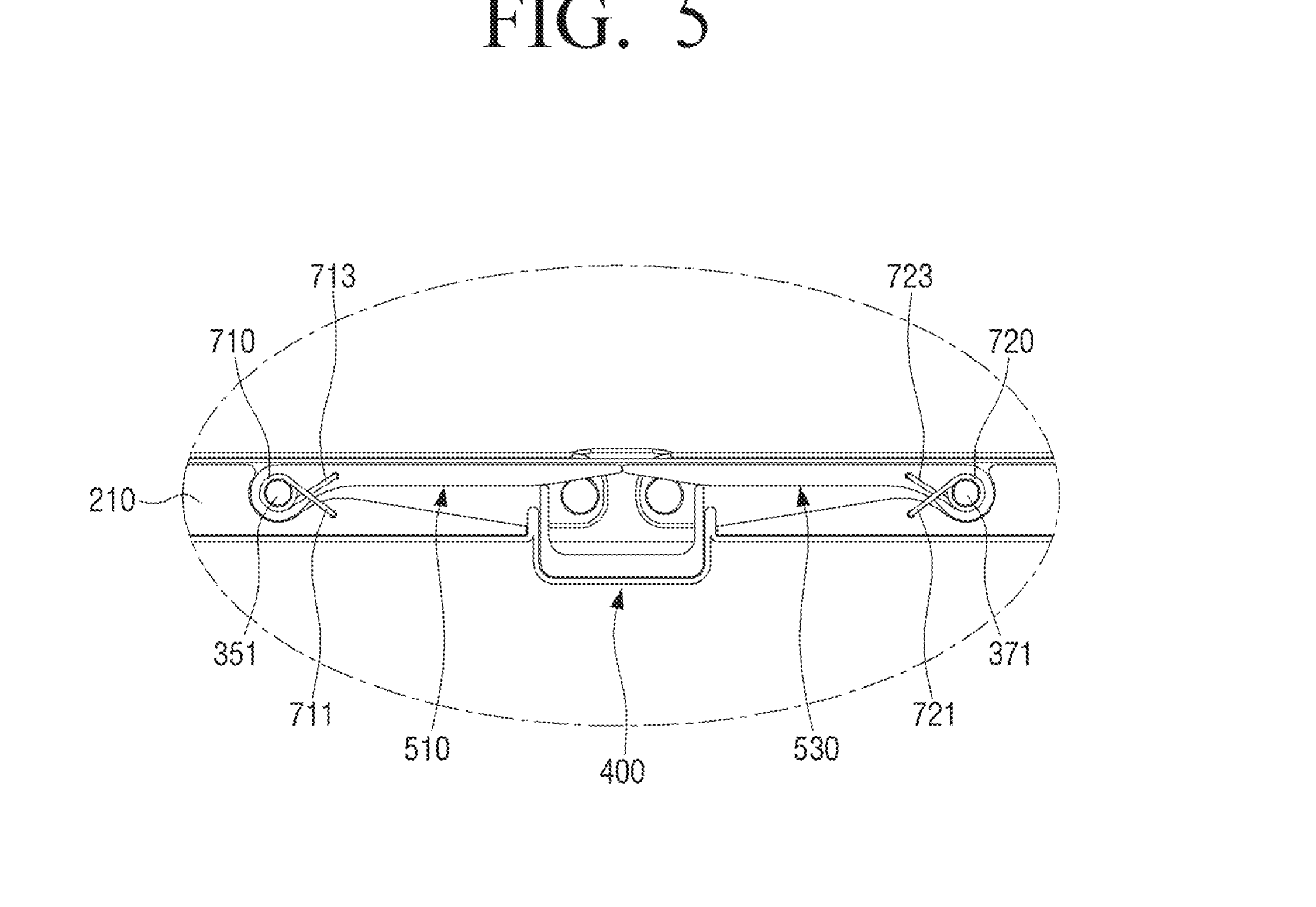
Title
Double-shaft hinge and electronic device
Gist of independent claim 1
A double-shaft hinge composed of mutually parallel first and second rotation shafts and a transmission device, the transmission device including first and second transmission members fixed to each shaft and a third transmission member meshing with both between them.
The prior art problem the specification states
The specification mentions only that existing approaches offer "fewer choices," rather than a specific problem. The framing is not described in as much detail as in the Samsung patent.
Numeric limitations
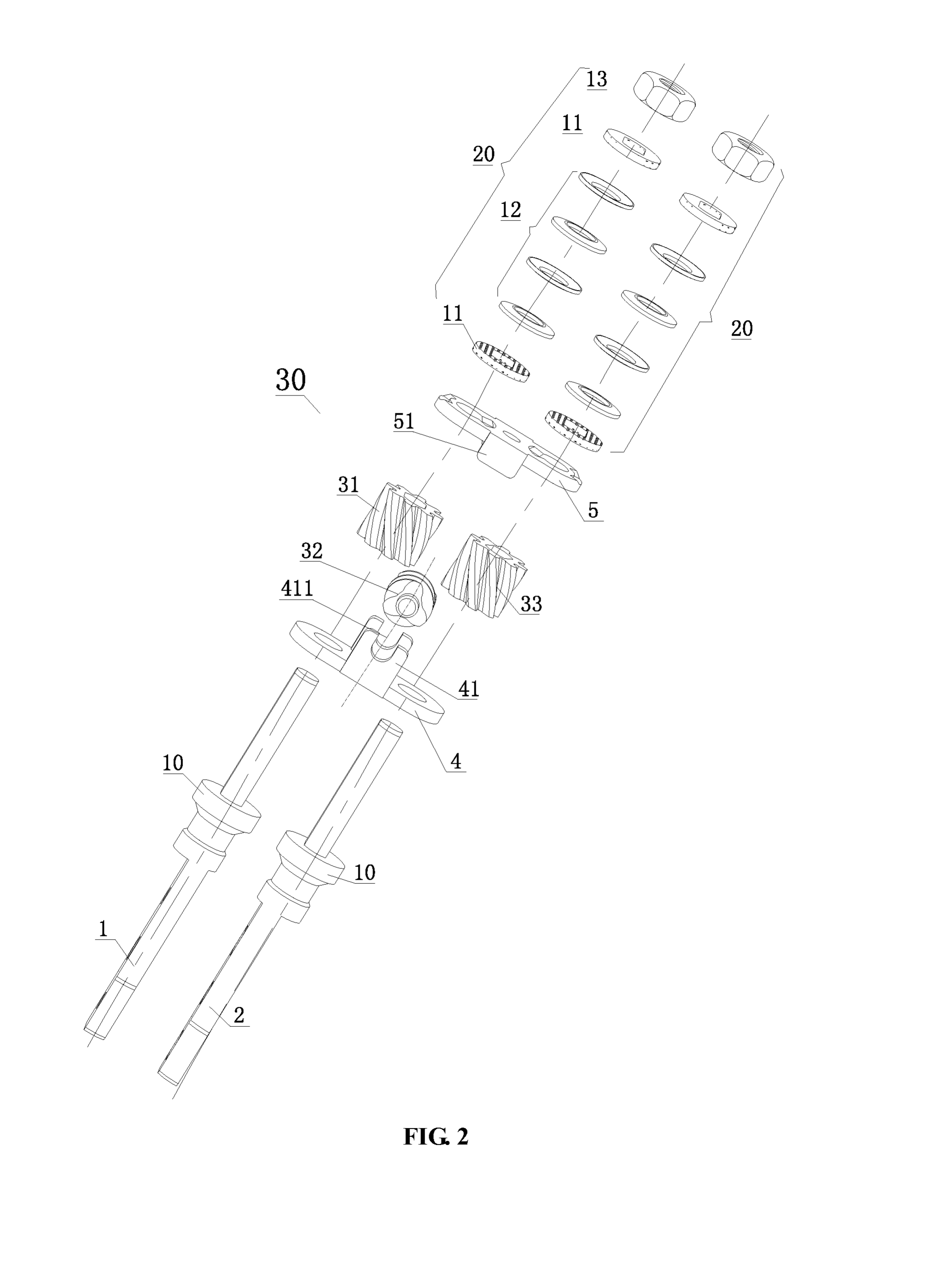
Title
Hinge mechanism having plate stops for a flexible display device
Gist of independent claim 1
A hinge mechanism including first and second components of a flexible touch display and a hinge sleeve structure from which at least one plate extends, wherein first and second plates joined to structural supports are stopped as they rotate relative to the hinge sleeve plate.
The prior art problem the specification states
That a flexible display has a radius of curvature when folded, making it hard to configure a folded segment without sacrificing thickness, and that structural hinge support is needed so it does not fold to an obtuse angle beyond the display's curvature limit.
Numeric limitations
Case name
Lepton Computing LLC v. Samsung Electronics, Co., Ltd. et al
Gist of the complaint
A patent infringement suit filed in the Eastern District of Texas. It claims the Galaxy Z Fold, Flip and Tri-Fold infringe nine patents relating to flexible displays, hinge mechanisms, UI transitions and more.
The background Lepton states for itself
Lepton calls itself "the original developer of the foldable phone" and claims concepts and prototypes going back to 2008 (it has never actually launched a commercial smartphone).
Numeric limitations
4. Comparative analysis
4.1 Lepton’s two waves: 2010 and 2020 are different stories
Lay Lepton Computing’s patents out by priority date and two distinct waves appear. The first wave is the “reconfigurable segment display” concept beginning in August 2010 with a provisional application (US 61/372,391), continuing through several continuations to this day. It covers connecting four or eight 4.3-inch segments with flexible circuits to reconfigure from phone size to tablet size, and claims no particular hinge structure.
The second wave is the “hinge mechanism having plate stops” of March 2020. It defines the folding angle range as under 10 degrees fully folded and 170 to 190 degrees fully extended, and claims a structure in which plates extending from the hinge sleeve stop the rotation. This is the patent that can actually be compared with Samsung’s physical hinge. And its priority (2020-03-25) is 6 months later even than the Galaxy Z Fold launch (2019-09).
That is, for the claim that “Lepton is the originator” to hold, it first has to be said which wave is meant. For the broad concept it is right. For the hinge itself it is, at least against the Samsung and Lenovo patents confirmed here, late.
4.2 Samsung versus Lenovo: the 2014 contest split by 7 months
In February 2014 Samsung Electronics filed a hinge structure making an “accommodation space” where the two bodies fold, supporting the folded display panel so it is not pressed. That patent (US9250733B2) has been cited by 305 subsequent patents, which means it is a foundational patent the industry as a whole references.
In September of the same year Lenovo Beijing produced a different approach: a “double-shaft hinge” (US9611680B2) placing transmission members between two parallel rotation shafts so they turn in mesh. Where Samsung claimed a space supporting the folded portion, Lenovo claimed the meshed transmission structure itself. Same period, same problem, different mechanism.
A gap of 7 months does not mean “Samsung influenced Lenovo.” Given that the two claim structures are fundamentally different, they may have been developed independently. That was not confirmed, though.
4.3 The suit: what is it aiming at?
The suit filed on 23 April 2026 (Lepton Computing LLC v. Samsung Electronics Co., Ltd. et al, case number 2:26-cv-00338, Eastern District of Texas) has Lepton calling itself “the original developer of the foldable phone,” claiming concepts and prototypes going back to 2008. The complaint claims the entire Galaxy Z Fold, Flip and Tri-Fold line infringes nine patents relating to flexible displays, hinge mechanisms and UI transitions, and demands a sales injunction.
On the evidence of the two patents that could be confirmed, this suit is favourably placed in time if it leans on the “concept” patent (2010) and unfavourably if it leans on the “hinge structure” patent (2020). Which of the two each of the nine attached patents is exists only in the court record (PACER, paid) and could not be confirmed in this survey. So this article makes no judgement that “Lepton wins” or “loses.”
5. Counter-evidence and limits
The two confirmed patents are not asserted to be the same as the nine attached to the suit. The earliest by priority (2010) and the closest to a hinge (2020) were chosen from Lepton’s Google Patents assignee list; the actual list of asserted patents in the complaint (PACER, paid) could not be confirmed.
Priority advantage is not read as an advantage in patent validity. That the 2010 patent is earlier is separate from whether its claims actually cover Samsung’s hinge structure. That is for a court to judge.
The time gap between Samsung and Lenovo is not read as causal. Filing 7 months earlier is no grounds for saying Samsung influenced Lenovo. The claim structures themselves differ.
Commentary a tool attaches is not used without verification. Opening Huawei’s CN217847335U, mentioned in a web search result, showed it to be a patent on label packaging material. Entirely unrelated. It was excluded from the article. Cited without checking, a non-existent Huawei patent would have gone in as though it were real grounds.
A limit in obtaining figures. The original figures of the Samsung patent (17 figures confirmed to exist) could not be obtained this session because access to the Google Patents viewer was unstable. What was not confirmed is stated as such rather than asserted to be absent.
6. Conclusions and implications
The press’s one-line summary of a “timing problem” was half right. Lepton’s hinge structure patent (2020) is certainly later than Samsung’s (2014) and Lenovo’s (2014). And yet Lepton’s broader concept patent (2010) is earlier than anyone’s. The outcome of the suit depends on which patents the complaint actually aims with, and with which claims, and that is not for CLAIM to judge but for a court. What this survey did confirm is that “the whole suit cannot be measured by the single grant date the press cited.” A next piece could complete this verification by obtaining, through PACER, the list of nine patents actually attached to the complaint.
- search strings
- assignee:(Lepton Computing), sort=old, checking Lepton's whole portfolio in priority order. Samsung and Lenovo were compared directly by individual patent number
- reference dates
- priority date basis, 2010 to 2026
- data obtained
- 2026-08-14
- classification rule
- patent type (concept patent versus hinge structure patent) × company
This analysis is a compilation based on published patent gazettes and public reporting, and is not the official position of any company or party to the litigation. It makes no judgement of its own on infringement or invalidity.
7. Appendix: full patent specification
| Company | Patent number | Status | Priority | Family |
|---|---|---|---|---|
| Lepton Computing (concept) | US11106242B2 | granted | 2010-08-10 | US (many continuations), WO |
| Samsung Electronics | US9250733B2 | granted (cited 305) | 2014-02-17 | US, KR |
| Lenovo Beijing | US9611680B2 | granted | 2014-09-03 | US, CN, DE |
| Lepton Computing (hinge) | US11614779B2 | granted | 2020-03-25 | US (continuation US12124301B2), WO |
| the suit | 2:26-cv-00338 | pending | filed 2026-04-23 | Eastern District of Texas |