
Seven foldable ultra-thin glass (UTG) patents analysed
Schott filed an opposition against the foldable glass patent Corning had granted in 2014, and the European Patent Office answered with revocation. Open seven foldable glass patents in priority order, from Corning to Dowoo Insys in 2024, and the real competitive structure of the materials supply chain appears. A comparison of the claims in the originals, for buyers and planners reviewing ultra-thin glass sourcing.
This article was published before the English edition began, so the labels inside its figures and simulators are in Korean. The caption and the note under each figure are in English.
In 2014 Corning had a patent granted on stacking bendable glass into an assembly. Schott raised the question with the European Patent Office (EPO) of whether that patent was actually reproducible. The board revoked two of them and one remained under examination. Corning retains a right of appeal. This is not conjecture or narrative but the published EPO case record. Taking that litigation as a starting point, we opened all seven foldable glass patents in priority order, from Corning in 2014 to Dowoo Insys in 2024.
1. Overview
1.1 Background and purpose
The cover glass of a foldable display carries the contradiction that “the thinner it is the better it folds, and the thinner it is the more easily it breaks.” How that contradiction is actually being resolved is confirmed from the originals of granted and published patents. The purpose is confirmation, not prediction. What the companies actually wrote in their specifications is carried over as it stands.
1.2 Scope
No period was set, because confirming when foldable glass as a technology was actually first patented was one of the core tasks of this analysis. It covers seven patents over 10 years, from 2014 to 2024 by priority date. The companies are Corning, Schott (two), Samsung Display (three) and Dowoo Insys.
1.3 Data source and search strings
| Item | Content |
|---|---|
| Data source | Google Patents (patents.google.com), single source. Paid registers such as KIPRIS were not obtained |
| Search method | Exact phrase searches "foldable glass substrate" and "bendable glass". Broad keywords (such as “ultra-thin glass”) mixed in irrelevant results and were discarded |
| Sort order | Oldest first (sort=old) checked first, then supplemented toward the newest. A previous attempt confirmed that using newest-first alone misses the founding patents of older companies |
| Selection method | After comparing against the originals to check the exact phrase was actually used in a foldable display context, representativeness was confirmed with the B-1 indicators (family country count, grant status, abandonment or lapse, divisional and continuation filings) |
| Limits | A 7-patent sample analysis, not an exhaustive survey. Claim counts, inventor counts and family sizes were not used as indicators (cases distorted by continuations and divisionals were confirmed) |
1.4 Technical classification
The collected patents were classified on two axes, “what is changed (the lever)” and “what is aimed at (the goal).” The levers are three: structure (layer and stack arrangement), process (strengthening treatment and property specifications) and material substitution (changing the glass itself for another material). The goals are two: strength (impact resistance) and appearance (visibility of the fold mark).
2. Quantitative sketch
Since this is not an exhaustive survey, instead of counting “how many,” the seven patents obtained are arranged three ways — by time, by lever and by figures — to check their relative positions.
2.1 Technology roadmap: by priority date
The Corning (2014) to Schott① (2015) span joined by the solid line is the actual pair of parties in the EPO litigation. The Samsung Display① (2019) to Dowoo Insys (2024) span joined by the dashed curve is where the same idea — “treat the folding region differently from the non-folding region” — reappears five years later at a different company, by a different means and for a different goal. The real first wave of foldable glass patents was not in 2026 but already in 2014 and 2015.
2.2 Lever × goal matrix
Six crowd into the strength row and one into the appearance row. Dowoo Insys (appearance row) and Samsung Display① (strength row) are both in the “structure” column and both share the higher-level idea of “treating the folding region differently from the non-folding region,” but their concrete means differ. Samsung Display① varies the depth of chemical strengthening (the second layer) by region, while Dowoo Insys etches away thickness by region. It is closer to a case of the same idea splitting into different tools for different goals.
2.3 Figures compared: compressive stress (CS) ranges
The compressive stress ranges specified by three patents — Corning (2014), Schott② (2018) and Samsung Display③ (2021) — overlap broadly around 100 to 2000MPa. Which means that across a gap of seven years, and using different levers (stack structure, glass-ceramic, molten salt process), they arrived at the same numerical range. This overlap does not mean the actual strength of the three companies’ products is the same. Measurement thickness and test conditions may differ by specification, so no direct comparison is made (see the counter-evidence in Section 5). The Schott①, Samsung Display① and ②, and Dowoo Insys patents do not state CS numerically and are excluded from this chart.
3. Qualitative analysis: seven patents
Arranged chronologically. The full gist of claim 1, the prior art problem the specification states for itself, and the numeric limitations are quoted as they stand.
Title
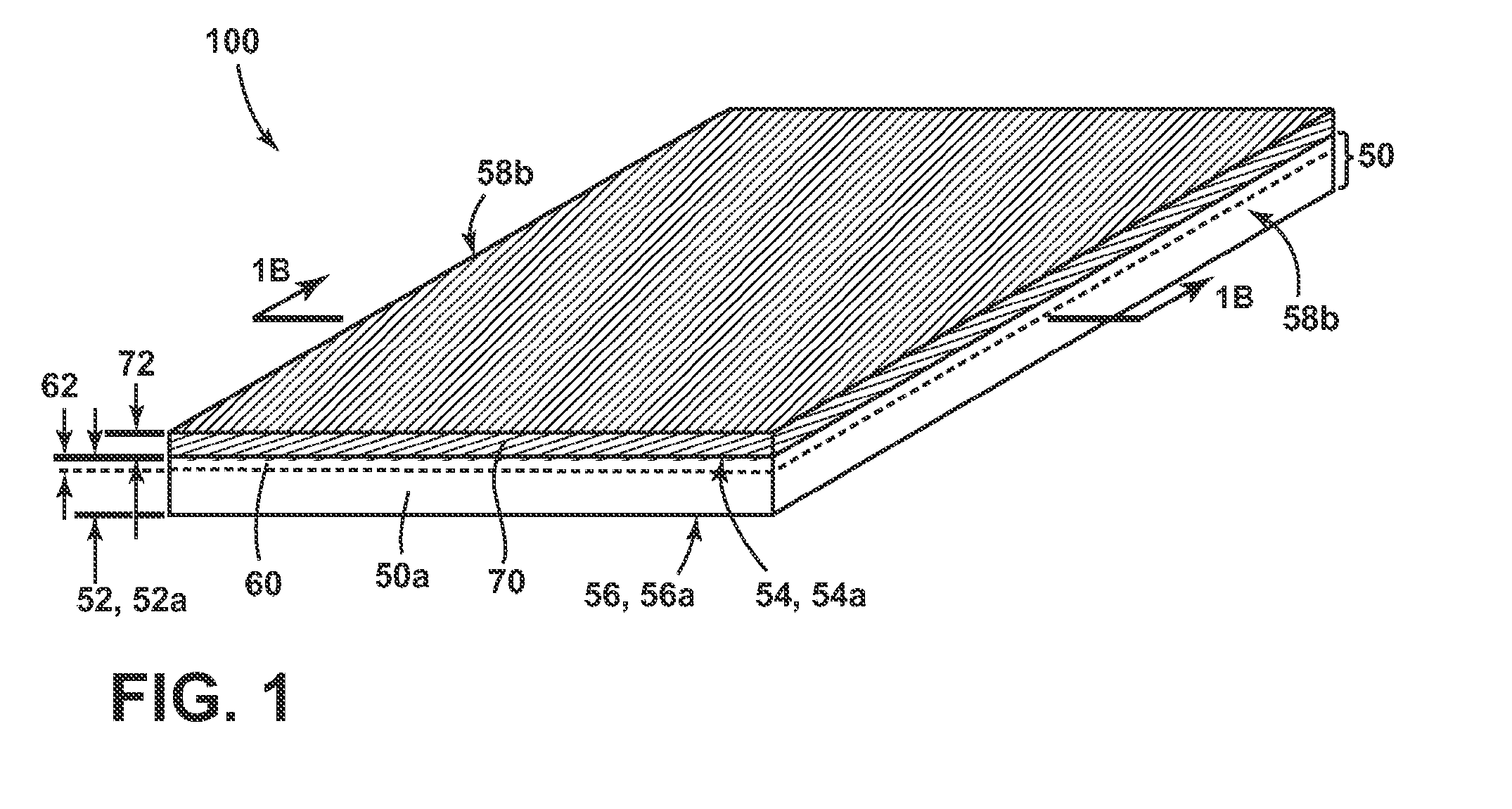
Bendable glass stack assemblies, articles and methods of making the same
Gist of independent claim 1
A stack assembly configuration comprising a glass element about 25 to 125μm thick and a compressive stress region formed from its first major surface to a given depth.
The prior art problem the specification states
Metal foil has "high cost and a lack of optical transparency," polymer film "marginal optical transparency, lack of thermal stability and limited hermeticity." It names the limits of existing materials for flexible displays.
Numeric limitations
Title
Long-term bendable glass material and method for producing a long-term bendable glass material
Gist of independent claim 1
A long-term bendable glass material in roll form, under 500μm thick (minimum 3μm), with a probability of failure within half a year below 0.1 even after storage at a radius of curvature R for a day or more, and not exceeding the critical crack depth.
The prior art problem the specification states
It names the problem that "even a single failure is already a serious problem" and that existing research did not consider the aspect of "delayed breakage" or long-term stability. The point that not breaking once and not breaking for a long time are different problems.
Numeric limitations
Title
Glass substrate, method of manufacturing the same, and display device including the same
Gist of independent claim 1
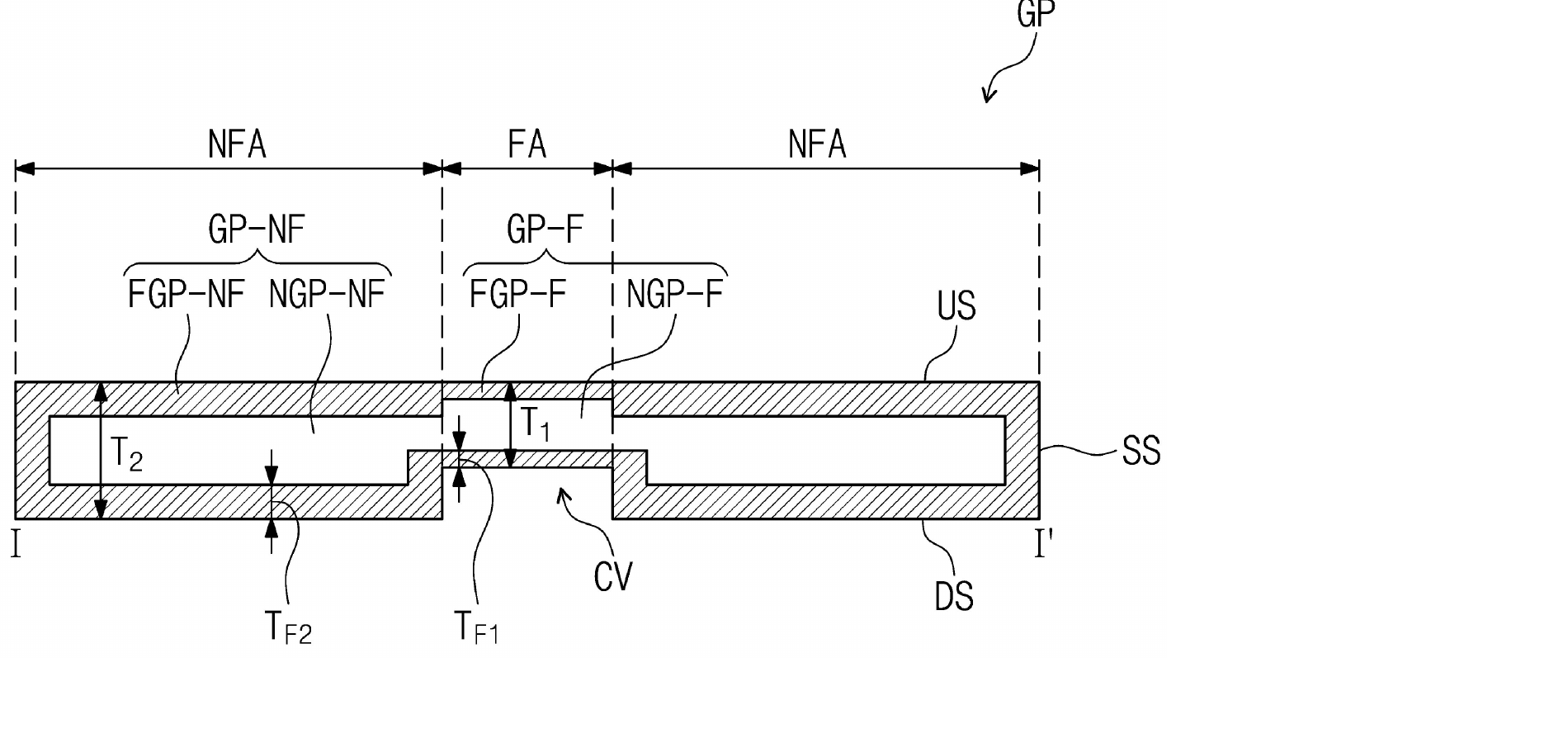
A glass substrate including a folding portion of a first thickness and a non-folding portion of a greater second thickness, both portions including a first layer and a second layer (a chemically strengthened layer) surrounding it with greater compressive stress, wherein the depth of the second layer in the non-folding portion is greater than in the folding portion. (claim 12)
The prior art problem the specification states
The specification does not present a specific prior art problem as a quotation, stating only the general background that research into glass substrates of improved durability is under way for application to display devices. Unlike the other cards, this patent has no clear sentence criticizing prior art.
Numeric limitations
Title
Ultrathin glass ceramic article and method for producing an ultrathin glass ceramic article
Gist of independent claim 1
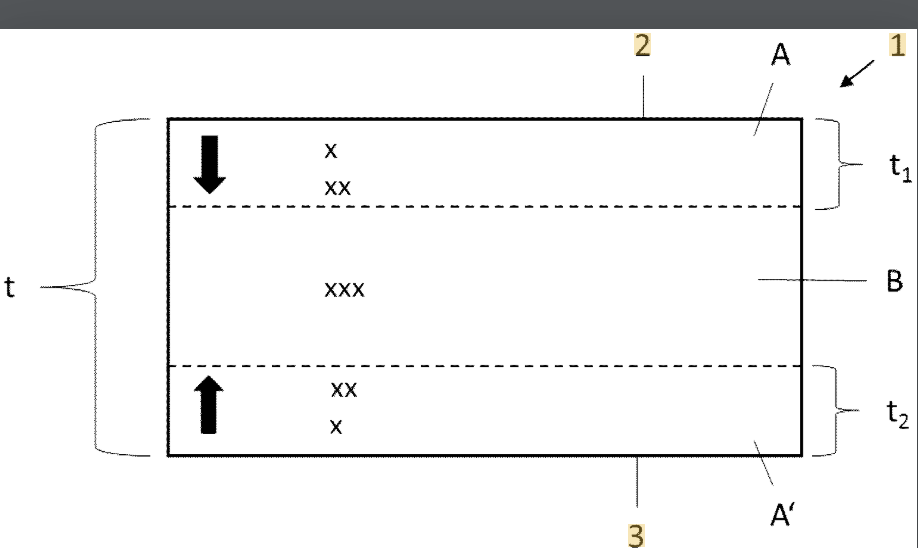
An ultrathin glass-ceramic article of thickness (t) 0.3mm or less, composed of outer layers containing a crystalline phase and an amorphous central portion, having a gradient structure or a layered structure.
The prior art problem the specification states
"Glass has a quite low break resistance and poor anti-scratch resistance," and "pen drop tests in flexible display show low breakage heights e.g., only a few centimeters." The problem that strengthened glass alone is insufficient in break and scratch resistance.
Numeric limitations
Title
Glass article, display device including the glass article, and method of manufacturing the glass article
Gist of independent claim 1
A glass article composed of a flat portion and a side portion curved in the thickness direction, including a base and a Beilby layer, wherein the Beilby layer is disposed on the flat portion and not on at least part of the side portion.
The prior art problem the specification states
"Glass articles applied to them are frequently exposed to external impacts." The conflicting demand of being thin while withstanding external impact. Impact resistance is quantitatively verified by crack width, length and count and by ball drop testing.
Numeric limitations
Title
Glass strengthening molten salt and glass strengthening method using the same
Gist of independent claim 1
A method of strengthening glass with a molten salt whose solidification point is about 220℃ or more and under 320℃. The molten salt is composed of a first salt containing KNO₃ and a second salt containing one or more of Li⁺, Na⁺, K⁺, Cs⁺ and Rb⁺.
The prior art problem the specification states
"Residual salts may be frozen on the surface," with the resulting interfacial stress and surface damage, cracks, dents and wrinkles. The problem that residual salt left on the glass surface after the strengthening bath solidifies as it cools and induces defects.
Numeric limitations
Title
Method of partially etching the folding region of glass so that it is invisible
Gist of independent claim 1
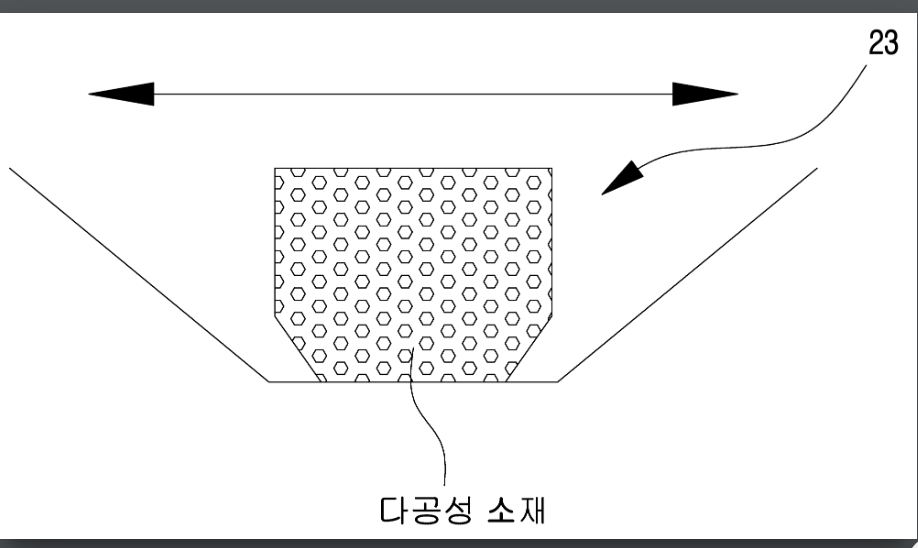
A method including the step of placing an etchant application means (23) over the folding region of the glass, and the step of reciprocating it with a moving means while gradually increasing the travel distance over time to form a flat folding surface and an inclined slope surface.
The prior art problem the specification states
The problem that "a steep inclined surface of 10 degrees or more relative to the horizontal is formed at the folding region and its boundary," leading to "the boundary of the folding region being easily identified by the naked eye" and "degraded image quality." A problem of visibility (appearance), not strength.
Numeric limitations
4. Comparative analysis
4.1 Corning versus Schott: the litigation that became a patent
In January 2014 Corning filed EP3099642 on a “stack assembly” structure piling bendable glass layer on layer. Glass element thickness 25 to 125μm, compressive stress 100 to 2000MPa, bend radius 3 to 20mm. It pinned down in concrete figures the specifications foldable glass must have, and is the earliest foldable-specific patent confirmed in this report. It was granted in March 2018.
Schott met it with an EPO opposition. The board’s issue, before whether the patent was valid, was “does it actually reproduce if you follow this method?” However precise the claims, the EPO doubted whether following the procedure written in the specification really produces that result. The sister patents in the same family, EP3099643 and EP3099644, were revoked in May 2020 and January 2021. EP3099642 itself had oral proceedings scheduled for 26 April 2021. Corning retains a right of appeal.
Schott was not idle in this period. In October 2015, 20 months after Corning, Schott filed its own patent (Schott①, later granted as US12130278B2). The approach differs. Where Corning claimed “how to stack it” (structure), Schott① took “how long it goes without breaking” (long-term bending durability) as its subject. Storage humidity 40 to 100%, storage period at least 1 day, probability of failure within half a year below 0.1. It defines in figures the condition of not breaking over time rather than in a single bend. This patent is still granted and active.
In summary: Corning claimed “how to fold it” first, and a good deal of it was revoked. Schott claimed a different question at almost the same time, “how long can it be folded,” and survived. Judgement on infringement or invalidity is not this article’s part. But that the two companies chose different claiming strategies before the same problem, and that the results parted, is what the EPO’s public record shows.
4.2 From Samsung Display to Dowoo Insys: the same idea over five years, a different means
In October 2019 Samsung Display filed its “glass substrate” patent (claim 12). The core is simple. Make the folding portion thinner than the non-folding portion, coat both with a chemically strengthened layer (the second layer), and give the non-folding side a deeper strengthening. The goal was strength. Since a thin folding portion and a thick non-folding portion sit under different stress conditions, the strengthening process was designed differently by region too.
In March 2024 Dowoo Insys filed a “method of partially etching the folding region so that it is invisible.” The higher-level idea is similar: treat the folding and non-folding regions differently. But the concrete means and goal differ. Unlike Samsung Display①, which used the chemical strengthening process (depth control), Dowoo Insys etches the surface away. The goal is not strength but visibility. The problem that a steep etching boundary of 10 degrees or more to the horizontal makes the fold mark visible to the naked eye is solved by etching the slope angle down gently to 0.5 to 1 degree or less.
Whether the two patents, five years apart, cite each other was not checked. No claim is made on citation grounds that “Dowoo Insys consulted Samsung Display.” What is left is only the factual relation that the same higher-level idea of “treating the folding region differently from the non-folding region” moved from a glass maker (Samsung Display) to a downstream process partner (Dowoo Insys), from chemical strengthening as the means to etching, and from strength as the goal to appearance.
4.3 Schott: a different branch three years later
Where Schott① (2015) defined “how long it goes without breaking” in glass as it is, Schott② (2018) changed the material category itself. Glass-ceramic. A gradient structure composed of outer layers containing a crystalline phase and an amorphous central portion. Varying the degree of crystallization by position, with the outer layer crystalline phase at 5 to 80vol% and the centre at 0 to 70vol%, it presents as a formula a bend radius better than pure glass (900×t mm or less). Its lower thickness bound is 0.03mm, the thinnest of the seven here.
Even within one company, two different branches appeared three years apart: “keep the glass and specify the properties precisely” (2015) and “change the material category itself” (2018).
4.4 Samsung Display: one company, three levers
Samsung Display’s three patents (① 2019 graded thickness chemical strengthening, ② 2020 Beilby layer structure, ③ 2021 molten salt process) split as structure, structure and process. ② designs impact resistance by placing the Beilby layer only on the flat surface of the folding portion and not on the curved part, verifying it with ball drop tests. ③ precisely controls not the glass composition but the strengthening process (the molten salt’s composition and solidification point), preventing solidified residual salt on the glass surface from causing interfacial stress. Which means one company is running levers in parallel rather than fixing on one before the same goal (strength).
5. Counter-evidence and limits
The EPO’s revocation decision is not extended into an assessment of Corning’s technology as a whole. What was revoked was a procedural issue over whether particular claims of the EP3099642 family are “reproducible as specified.” It is not read as meaning Corning has fallen behind across the foldable glass business. The appeal outcome and Corning’s subsequent patent strategy are outside this survey’s scope.
Overlapping figures are not read as a ranking of strength. The three patents whose CS ranges overlap (Corning, Schott②, Samsung Display③) may each have different measurement thicknesses and test methods, so the overlap is not interpreted as “equivalent strength.”
Citation relations are not read as causal without checking. That Samsung Display① (2019) and Dowoo Insys (2024) use a similar idea (treating the folding region differently from the non-folding region) was confirmed, but whether an actual citation or reference relation exists between the two patents was not.
Empty cells in the matrix are not read as “that company is not doing it.” This sample is only seven patents. It does not mean Corning and Samsung Display have no patents using the material substitution lever, only that none are in the sample obtained here.
Commentary a tool attaches is not used without verification. In an earlier survey an unrelated patent was hastily linked as “foundational technology of foldables.” In this session too, the patent number “Samsung Display① KR102244984B1” was initially used as it stood, and while re-searching for its figures, comparing the applicant directly against the original (the KIPO gazette) showed it was in fact a patent of an affiliate of China’s Kunshan Visionox. Passed over without verification, that error would have gone in as it was. It was replaced with the genuine Samsung Display patent (KR102810405B1) and the whole card rewritten.
A limit in obtaining figures. Original figures were included for Corning, Samsung Display①, Dowoo Insys and Schott②. Three — Schott①, Samsung Display② and ③ — could not be obtained this session. What was not confirmed is stated as such rather than asserted to be absent.
6. Conclusions and implications
What runs through foldable glass patents from 2014 to now is the absence of a standard solution. Corning went first with structure (stack assembly) and took a procedural blow at the EPO; Schott survived with a different claiming strategy (a long-term bending durability specification) at almost the same moment, then branched again three years later into an altogether different material (glass-ceramic). Samsung Display patented three levers at once (graded thickness chemical strengthening, the Beilby layer, molten salt), and one of them (distinguishing folding from non-folding portions) was reused five years later by Dowoo Insys with both means and goal changed, etching instead of chemical strengthening, appearance instead of strength. Which side gained an advantage in actual production cannot be judged from this sample. That is a matter of shipment volume and yield, not patents. A next piece could track the appeal outcome of EP3099642, or look for further cases like Schott① and ② where levers split within one company.
- search strings
- exact phrase searches "foldable glass substrate" and "bendable glass" plus applicant designation, results checked with sort=old (oldest first) first
- reference dates
- priority date basis, landmark patents selected from 2014 to 2024
- data obtained
- 2026-08-14
- classification rule
- a two-axis matrix of lever (structure, process, material substitution) × goal (strength, appearance)
This analysis is a compilation based on published patent gazettes and public EPO case records, and is not the official position of any company. It makes no judgement of its own on infringement or invalidity, and the EPO revocation and appeal status is cited on the basis of those case records.
7. Appendix: full patent specification
| Company | Patent number | Status | Priority | Family |
|---|---|---|---|---|
| Corning | EP3099642B1 | granted then revoked (appeal right retained) | 2014-01-29 | EP (sister patents US/WO etc. need confirmation) |
| Schott ① | US12130278B2 | granted | 2015-10-02 | US, DE, JP, CN |
| Samsung Display ① | KR102810405B1 | granted | 2019-10-31 | KR, US, CN |
| Schott ② | US20250002398A1 | pending | 2018-10-10 | KR, CN, WO, EP, US |
| Samsung Display ② | US20250346523A1 | pending | 2020-06-11 | KR, US, CN, EP |
| Samsung Display ③ | US20250353786A1 | pending | 2021-06-02 | KR, US, CN |
| Dowoo Insys | KR102714616B1 | granted | 2024-03-05 | KR |