
Indium Phosphide Quantum Dot Synthesis: Four Patents Samsung Could Not Void
Quantum dots give a purer color the more even their size. To grow cadmium-free indium phosphide dots evenly, Nanoco patented a method that puts in zinc-sulfur molecules, every one of them alike, as seeds. Samsung petitioned to have the patents cancelled, and all four synthesis patents survived. The gold particles in the document Samsung put in as evidence were of mixed sizes, and the zinc in the earlier paper was a dopant mixed in at trace amounts, not a starting point.
1. Overview
1.1 The same four patents, three endings
Nanoco, a British quantum dot company, fought three times in US courts between 2020 and 2026. The opponents were Samsung, LG Electronics and Japan’s Shoei Chemical, and all three ended in settlement. And all three had the same four patents at the center. They are patents on how quantum dot particles are made.
| Samsung | LG Electronics | Shoei Chemical | |
|---|---|---|---|
| Who sued whom | Nanoco → 5 Samsung entities | Nanoco → LG Electronics and its US subsidiary | Shoei → Nanoco (declaration of non-infringement), Nanoco counterclaim |
| Court, filing date | E.D. Texas 2:20-cv-00038 · 2020-02-14 | E.D. Texas 2:25-cv-00431 · 2025-04-24 | E.D. Virginia 1:25-cv-02135 · 2025-11-21 |
| Patents | ’828 ’423 ’557 ’365 + film ’068 | ’828 ’423 ’557 ’365 | ’828 ’423 ’557 ’365 (counterclaim) |
| Accused products (as alleged in the complaint) | Samsung QLED TVs (LCDs using a quantum dot layer), example model Q60R | LG products containing quantum dots, LG QNED TV (LCD) series | Shoei quantum dots used in some LG products |
| Ending | 2023-02 settlement, 150 million dollars (announced by Nanoco’s law firm) | 2025-11-20 no-fault settlement, 5 million dollars (Nanoco announcement) | 2026-03-26 settlement, no payment (Nanoco announcement) |
Lined up by amount alone, they are 150 million dollars, 5 million dollars and zero. This piece does not guess at the reason for those numbers. It reads instead, in the text of the decisions themselves, the technical reason Samsung failed to bring these patents down in the invalidity proceedings. The two later suits played out on top of those decisions.
1.2 Scope of the analysis
| Item | Value |
|---|---|
| Patent originals | Specifications and claims of the 5 patents in suit (Google Patents) |
| Decision originals | 5 final written decisions of the US Patent Trial and Appeal Board (IPR2021-00182~00186, 2022-05-16), obtained through public search |
| Court originals | Claim construction order (2021-05-11), 3 complaints, Federal Circuit order of dismissal (2023-02-08) |
| Announcement originals | Nanoco’s London Stock Exchange announcements |
| Analyzed | Of the 5 invalidity proceedings Samsung filed, the 4 synthesis patents. The 1 film patent (’068) was upheld on a separate ground unrelated to synthesis and is noted apart |
1.3 Terms
2. Why a seed was needed
2.1 Pour on a large scale and the temperature splits
Hot injection works well in a small flask. The problem comes with scale. The background section of the ’423 specification put the limit this way.
This method works well for small-scale synthesis. But on a large scale, where large volumes of solution must be poured rapidly into one another, temperature differentials can arise within the reaction, and these can lead to a broad particle size distribution.
US7803423B2 · Nanoco · backgroundOf the same material, a quantum dot emits a short wavelength (toward the blue) when the particle is small and a long wavelength (toward the red) when it is large. On the measured size curve for indium phosphide quantum dots (Almeida et al., Nano Letters 2023), a tetrahedron edge of about 1.5 nm gives a first absorption peak of about 450 nm, about 2.5 nm gives about 530 nm, and about 5.6 nm gives about 650 nm. Blue to red is divided within about 4 nm of edge length. To get the green and the red of a display out of the same material, the particle size is varied. So when particle sizes are uneven, dots that should give one color give slightly different colors, the emission spectrum broadens and color purity falls. Move the size and the size spread in the model below. The ’828 specification too wrote that the emission peak is watched during synthesis and the reaction cooled “when the desired emission is reached (which also means the desired particle size has been reached).”
The solution the specification offered is not to make the nuclei during the reaction.
Suitable nucleation sites are already provided within the system in the form of molecular clusters. The molecules of the cluster compound act as templates that direct nanoparticle growth.
US7803423B2 · Nanoco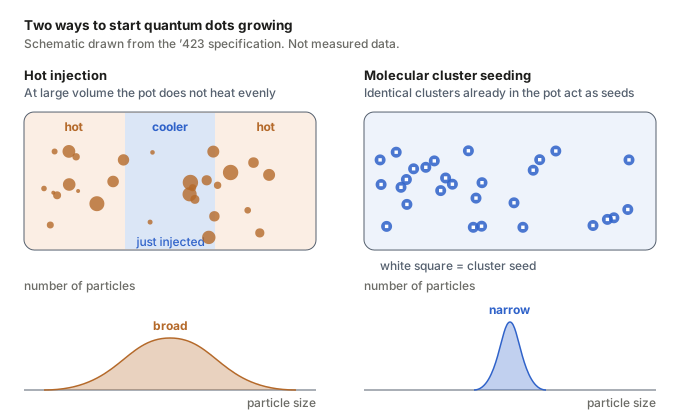
To be a template, the seeds have to be identical to one another. The specification nailed that condition down as a definition. A molecular cluster, it wrote, is a cluster so well defined in structure that every molecule has the same relative molecular mass (the ’828 says molecular formula), and the molecules are identical to one another “in the way that one water molecule is identical to another water molecule.” This one line comes back in Section 3.
2.2 Indium phosphide is hard to seed with the same material
In its complaint against LG Electronics, Nanoco wrote that cadmium has been banned from consumer electronics in a number of countries because of its toxicity. The representative material for cadmium-free quantum dots is indium phosphide (InP). Yet the ’828 specification itself wrote that a seed made of indium phosphide is hard to use.
III-V molecular clusters are notoriously difficult to make, whereas many kinds of II-VI molecular clusters can be made comparatively easily.
US7588828B2 · NanocoOnly a few III-V molecular clusters are known. They are moreover difficult to make and generally sensitive to air and moisture. Many II-VI molecular clusters, by contrast, are not sensitive to air or moisture and can be made by simple procedures.
US7588828B2 · NanocoThis is the applicant saying why its own invention was needed. Whether it still holds today was not checked for this piece. The answer the specification took was to borrow a seed of a different material. Indium phosphide, a III-V material, is grown on a II-VI cluster made of zinc and sulfur.
![US7588828 FIG. 3: a zinc sulfide molecular cluster [Zn10S4(SPh)16] (310) is combined with indium and phosphorus precursors (320, 330), and an indium phosphide core (350) grows on the cluster.](/articles/2026-09-22-nanoco-quantum-dot-synthesis-patent-litigation/fig2-us7588828-fig3-inp-on-zns-cluster.webp)
The worked example wrote down numbers as well. Starting the synthesis with 0.94 g of the zinc-sulfur cluster, it obtained “indium phosphide nanoparticles on a zinc-sulfur molecular cluster,” and the core treated with hydrofluoric acid had an emission peak of about 567 nm, a full width at half maximum of about 60 nm and a quantum efficiency of about 25 to 50 %. After a zinc-sulfur shell was applied, the figures are written as about 535 nm, a width of about 50 to 65 nm and a quantum efficiency of about 35 to 90 %. The specification carries no basis for comparison, so this piece does not judge whether these numbers are good or bad.
2.3 The four synthesis patents in the suits
| Patent | Gist of the independent claim | Priority | Expiry |
|---|---|---|---|
| US7803423B2 (’423) | A method of converting separated precursors into nanoparticles in the presence of a molecular cluster compound, under conditions in which seeding and growth occur | 2004-04-30 | 2028-01-25 |
| US7588828B2 (’828) | A nanoparticle with a group 13-15 core semiconductor on a molecular cluster compound holding group 12-16 ions. A continuation-in-part of the ’423, and exists only in the US | 2004-04-30 | 2026-10-27 |
| US8524365B2 (’365) | A nanoparticle made of a molecular cluster compound and a core semiconductor on it. A continuation of the ’423 | 2004-04-30 | 2025-04-27 (ended) |
| US7867557B2 (’557) | A core and two shell layers. The core is made in the presence of a molecular cluster compound different from the core precursor | 2005-08-12 | 2027-01-29 |
All four remain in Nanoco’s name. The fifth patent in the same suit, the ’068, is a method of making a film holding quantum dots, and lies off this line.
3. Samsung’s prior art was caught in two places
3.1 The court fixed the definition first
On February 14, 2020, Nanoco sued Samsung Electronics, Samsung Display, the Samsung Advanced Institute of Technology, Samsung Electronics’ VD division and Samsung’s US subsidiary in the Eastern District of Texas. In November that year Samsung petitioned for review of all five patents.
In the court’s claim construction (2021-05-11) Samsung argued that the term “molecular cluster compound” was indefinite. The court did not accept it. Finding that the patentee had defined the term itself in the specification, it fixed the meaning as “a cluster of three or more metal atoms and ligands, so well defined in structure that every molecule has the same relative molecular formula.” The court added that this construction was “substantially the same as that proposed by the defendants.”
The Patent Trial and Appeal Board instituted review on May 19, 2021, and in the ’423, ’557 and ’365 decisions wrote that it “agrees with the court’s construction.” The five final written decisions issued on May 16, 2022. Not one of the claims Samsung challenged was cancelled.
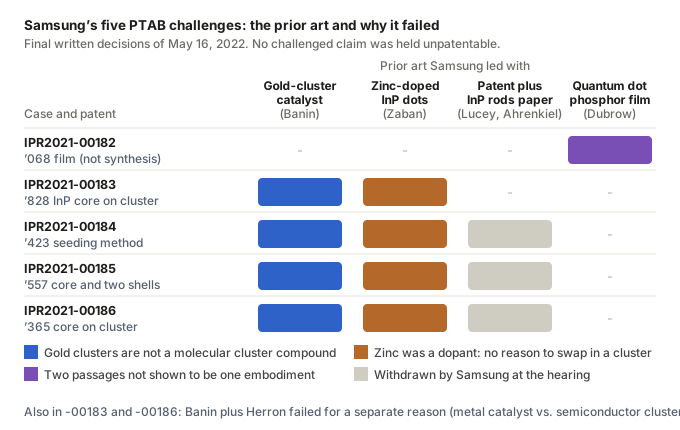
Blue and orange sit together in all four of the synthesis patents (00183~00186). That is, the prior art Samsung led with was caught in the same two places in all four. Those two places overlap exactly with the seed story of Section 2.
3.2 First: the gold cluster was not a seed whose molecules are all the same
Banin’s international application (WO 03/097904, 2003) is a method of growing semiconductor nanorods with a metal catalyst. As the catalyst it used a gold cluster “1.4 nm in diameter, of estimated molecular formula Au101(PPh3)21Cl5.” Samsung argued that this gold cluster was itself a molecular cluster compound, and rested that on the “estimated molecular formula” and the “average diameter” (’557 decision p25).
The Board traced where that formula came from. Banin made the gold cluster by the method of the Hutchison group (Weare et al., JACS 2000), and that paper wrote down how it had arrived at the formula. The decisions read the procedure as having “estimated the number of gold atoms in the metal core on the basis of an average particle size of 1.5 nm” (’423 decision p23, ’557 decision p26).
A person of ordinary skill would have understood Banin's "estimated molecular formula" as an average formula for a mixture of gold clusters of differing sizes. Those clusters are not identical to one another, nor are they so well defined in structure that every molecule has the same relative molecular formula.
IPR2021-00183 p24 · IPR2021-00184 p23 · IPR2021-00185 p26 · IPR2021-00186 p27This finding is the Board’s own. The Board accepted the testimony of Nanoco’s expert (Brandi Cossairt) as persuasive. That testimony pointed out that Hutchison had written the gold particles as “1.5 nm ±0.4 nm,” that is, a distribution spanning roughly 1.1 to 1.9 nm. It also relied on Banin’s own statement that the nanorods grown from this gold had a diameter distribution of 20 to 25 %. Of the electron micrographs in the two documents, the Board wrote that it “cannot discern a meaningful difference.”
If a formula is drawn from an average size, how many particles fit that formula exactly? Move the size spread in the model below.
With the spread at 0.4 nm, fewer than 2 % of the particles have exactly 101 atoms. Bring the spread down to 0 and every particle has the same formula. That is the molecular cluster compound the patents defined. The Au101 attached to the gold cluster was a label, not a formula every molecule shared.
The grounds led by Banin were caught by this finding in all four decisions. The ’365 decision wrote that the finding disposes of the Banin anticipation ground and the Banin-alone obviousness ground together (p30).
3.3 Second: the zinc put into indium phosphide was a dopant, not a seed
Samsung’s second route was Zaban’s 1998 paper (Langmuir). It is a paper that made indium phosphide quantum dots in order to sensitize a titanium oxide electrode. Indium oxalate and a phosphorus precursor were heated at 260 to 280 °C for three days, and zinc acetate was put in. Zinc, in other words, was already going into the indium phosphide synthesis.
Samsung argued that putting a cluster of ten zinc atoms in the place of that zinc acetate gives the claim. In the ’828 and ’365 proceedings it brought in Zn10S6Ph12 from the Farneth paper, and in the ’423 and ’557 proceedings Zn10O4(OAc)12 from the Ptatschek paper.
What it caught on was the role of the zinc. Zaban put the zinc in as a dopant and set the ratio of indium to zinc so that there was “on average one Zn2+ ion per particle.” By the ratio one decision gives (’557 decision, p35), that is one zinc to about 1,000 indium.
![Schematic of two indium phosphide dots. Left: prior art Zaban adds zinc as a dopant, on average one zinc ion per particle. Right: Nanoco's example grows the InP core on a cluster [Zn10S4(SPh)16] carrying ten zinc atoms in one molecule.](/articles/2026-09-22-nanoco-quantum-dot-synthesis-patent-litigation/fig4-zinc-dopant-vs-ten-zinc-cluster.svg)
In its briefing Nanoco argued that “any quantum dot into which that cluster is introduced would end up with at least ten times the zinc Zaban calls for.” The Board accepted that this was right (’828 decision p40~41, ’423 decision p34, ’365 decision p45). And it made a finding of its own.
Petitioner has not persuaded us that a person of ordinary skill would have recognized that zinc cluster as a substitute functioning in the same way as the zinc acetate dopant of Zaban's process.
IPR2021-00183 p41 · IPR2021-00184 p36 · IPR2021-00185 p33~34 · IPR2021-00186 p45The four decisions also wrote that the substitution rests on hindsight, a reconstruction fitted backward after seeing the invention. One caution. The ’365 decision first made clear that the claims do not require one zinc per particle (p45). What the Board divided was not the scientific line between a seed and a dopant, but whether there was a reason to put a ten-zinc cluster into a process designed around a dopant.
3.4 The other grounds
- Herron (’828, ’365): Samsung also proposed putting the cadmium sulfide cluster of the Herron paper in the place of Banin’s gold catalyst. Separately from the gold cluster finding, the ’365 decision gave one more reason: Banin’s method needs a metal catalyst, and that cluster “is not a metal” (p36). The ’828 decision likewise wrote that Samsung had failed to explain this difference (p31)
- Lucey and Ahrenkiel (’423, ’557, ’365): Samsung withdrew these grounds itself at the oral hearing on February 23, 2022, so there is no finding on them
- Film patent ’068 (00182): It was upheld on the ground that there was no showing that two different paragraphs of the prior art Dubrow describe the same embodiment. Unrelated to synthesis, it is taken out of this piece’s denominator
4. The two suits behind the decisions
4.1 Samsung: the appeals dismissed and the film patent moved
Samsung appealed the synthesis patent decisions. On February 8, 2023, the Federal Circuit dismissed the four appeals (22-1848~1851) on the agreement of the parties. The law firm that represented Nanoco announced the settlement at 150 million dollars. A month later, on March 7, 2023, the film patent ’068 and three of its continuations, four patents in all, were assigned to Samsung Electronics (US assignment records). The four synthesis patents stayed with Nanoco.
4.2 LG Electronics: the decisions became the ground of a complaint
On April 24, 2025, Nanoco sued LG Electronics and its US subsidiary on the four synthesis patents. As accused products the complaint named every LG product containing quantum dots and listed the LG QNED TV (LCD) series. And as grounds that the patents are valid it cited the four final written decisions of the Samsung case directly in its footnotes, asserting that “the Patent Trial and Appeal Board examined more than 40 claims and confirmed their novelty and non-obviousness.”
The complaint also sets down the two companies’ past: that LG had been evaluating Nanoco’s quantum dot technology from 2007, that the two worked together from 2012 to 2017, and that in March 2012 Nanoco pointed LG to the ’828 patent. These are all the plaintiff’s allegations.
On November 20, 2025, Nanoco announced that it had ended the suit against LG Electronics by a “no-fault agreement.” The total is 5 million dollars and the remaining terms are undisclosed. On January 15 the following year it announced that it had received 4.5 million dollars from LG Electronics and its US subsidiary, net of 10 % withholding tax.
4.3 Shoei: the supplier went to court first
To read Shoei you have to start with Nanosys. Nanosys is a US quantum dot maker, a different company from Nanoco. According to Nanoco’s announcements, the Japanese electronic materials company Shoei Chemical bought most of Nanosys’ assets in September 2023 for an undisclosed sum. According to Shoei’s complaint, the US subsidiary in Milpitas, California (Shoei Electronic Materials) handles the research, development and sale of Shoei’s quantum dot technology. In its announcement Nanoco described Shoei as “a company supplying quantum dots to a number of global technology companies.” Shoei is not a company that bought Nanoco’s patents; it is a company that became a quantum dot supplier by buying another quantum dot company.
On November 21, 2025, the day the LG case was dismissed, Shoei Chemical and its US subsidiary filed suit in the Eastern District of Virginia seeking a declaration that they do not infringe Nanoco’s patents.
Shoei’s complaint set down the reasons. Shoei quantum dots were used in some LG products, and Nanoco had cited Shoei’s products and manufacturing methods extensively in its infringement contentions in the LG case. It also quoted the passage where an interrogatory Nanoco served in the LG case demanded “records of production, since September 2023, of quantum dots made with Shoei technology in Milpitas, California and incorporated into LG products.”
On January 12, 2026, Nanoco counterclaimed on the same four patents, and on February 23 it announced that it had moved to add Apple as a co-party. Neither the reason for the motion nor the court’s ruling on it appears in the announcements or on the public docket. On March 26 the two companies ended the matter by settlement.
Neither side pays compensation and each bears its own costs. Nanoco will not sue Shoei or its customers and suppliers over the use of its quantum dot patents in the display field, and Shoei will not sue Nanoco or its customers and suppliers over the use of its quantum dot patents in the sensor field. Existing patents and new patents granted within the next three years are all covered.
Nanoco announcement · 2026-03-26The sensor field here is the side that receives light, not the side that emits it. In its company description Nanoco writes that its quantum dots are aimed at the sensor, electronics and display markets, and that the product line tuned to absorb the near infrared is used in cameras and image sensors. Each company, in effect, cleared one side for the other.
The settlement did not change who owns the patents. The four synthesis patents stand in Nanoco’s name as before. What Shoei got is a promise that Nanoco will not sue it for making and selling quantum dots for displays, and that promise reaches the customers who use Shoei’s quantum dots as well.
5. What this analysis does not say
- What a complaint says is the plaintiff’s allegation. No court ruled on which product actually infringed which claim
- Why the settlement amounts fell is unknown. 150 million dollars, 5 million dollars and zero are lined up with their dates and nothing more; no causal link to patent expiry or to the decisions can be supported from the material
- “III-V clusters are difficult to make” is a statement in a specification of the 2000s. The present state of the art was not checked
- On the zinc, what the Board decided was that “there was no reason to make the swap.” It did not set a scientific criterion dividing a seed from a dopant
- Within the decisions the wording of the definition runs sometimes as “the same” and sometimes as “approximately the same.” This piece follows the wording of the court’s construction
- The motion to add Apple as a co-party could not be read in the original. It is not on the public docket and sits only in the paid retrieval system
- The remaining terms of the Samsung and LG settlements, and whether the Samsung settlement includes a license, could not be confirmed in the originals
- Proceedings outside the US, in Germany, China and elsewhere, are not covered
6. When they open up
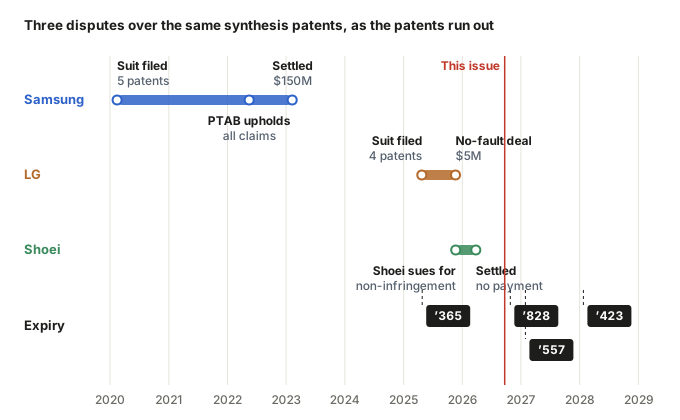
| Expiry | Patent | What it claimed | Owner |
|---|---|---|---|
| 2025-04-27 (ended) | US8524365B2 | Product a core on a molecular cluster | Nanoco |
| 2026-10-27 | US7588828B2 | Product a group 13-15 core on a group 12-16 cluster | Nanoco |
| 2027-01-29 | US7867557B2 | Method making a core in the presence of a cluster, plus two shell layers | Nanoco |
| 2028-01-25 | US7803423B2 | Method seeded synthesis in the presence of a molecular cluster | Nanoco |
| 2035-06-22 | US9680068B2 | Method making a multiphase resin quantum dot film | Samsung Electronics |
The ’828, which claims a particle with indium phosphide grown on a zinc-sulfur cluster, expires 35 days after this issue goes out. The ’365, which carries the same priority date, has already ended, and the ’423, which claims the seeded synthesis method itself, runs longest, to January 2028.
Expiry is the day on which a claim can no longer stop use after it. It does not make disputes over use in the period before expiry disappear on that day. This piece has an example. The ’365 expired on April 27, 2025, three days after Nanoco sued LG Electronics, and it was still among the four patents named in the complaint.
What opens up when depends on whether the patent claimed a product or claimed a method. Two of the four claimed a product. The ’365 (a particle with a core placed on a molecular cluster) has already ended, and the ’828 (a group 13-15 core on a group 12-16 cluster) ends on October 27, 2026. Once that day passes, no right claiming the particle itself remains in this family. The two that remain are methods. The ’557 claims the manufacturing method of putting two shell layers on a core until January 2027, and the ’423 the manufacturing method of growing with a molecular cluster added until January 2028.
A method patent reaches a different place than a product patent. US patent law treats bringing into or selling in the United States a product made by that method as infringement too (35 U.S.C. §271(g)). The complaint against Samsung hung this provision on the ’423 and the ’557, which claim methods, and not on the ’365, which claims a product. So the expiry date of the ’423 carries meaning for those who buy their quantum dots from outside the country as well.
All three disputes happened inside this span. Samsung ended in February 2023 at 150 million dollars, and LG Electronics ended in November 2025 with a no-fault agreement (the 5 million dollars was received in January 2026). Shoei Chemical went to court first, in November 2025, to seek a declaration of non-infringement. On the four patents this article covers, this is as far as the facts now confirmed go.
7. So where does it stand now
The patents this piece covered are ways of making the kernel of a quantum dot, the core. They were filed in 2004 and 2005 and end within the next one to two years. In the meantime the battleground for quantum dot materials has moved outside the core. The ’068, which passed to Samsung Electronics a month after the settlement, is a method of making a film holding quantum dots, and remains until 2035. The 316 quantum dot color conversion layer patents covered in the last issue claim the top plate that turns blue light into red and green, that is, not the particle but how the particles are arranged and confined. Most of them expire in the 2030s as well.
But size uniformity, the subject of this piece, is not a finished problem even now. The 2023 paper used in the simulator calls indium phosphide quantum dots “the main alternative to the cadmium-based materials regulated for their toxicity,” and in the same paper wrote this.
The smaller the particle, the tighter the size distribution has to be for a narrow emission width. (…) This is one of the reasons it is difficult to obtain indium phosphide quantum dots with a narrow emission width in the visible.
Almeida et al. · Nano Letters 2023In the same paper the emission width of a single particle is 60 to 80 meV, but measured over an ensemble of those particles it went over 200 meV. The difference comes from particles differing in size from one another. It is the same place as the problem the 2004 specification wrote down as a size distribution broadened by temperature differentials. Nanoco answered with a seed, and that answer held in court, but on the materials side it is still being worked out.
The companies’ positions have split apart. In the March 2026 settlement Nanoco and Shoei Chemical divided the fields between display and sensors and agreed not to sue each other. Nanoco’s July 2026 preliminary results show revenue excluding licensing of 1.5 million pounds, with the sales effort described as “mainly on the sensor side.” The fight over who makes the quantum dot core has been settled this way, and the ground that remains has moved to where and how that core is laid down.