
Samsung, Caught by an OLED Lighting Patent: The Pictiva Settlement
The two OLED patents behind the $191.4 million jury verdict against Samsung in November 2025 came not from displays but from lighting. They date from OSRAM's OLED lighting days, and on August 11, 2020 they passed to a patent assertion entity that changed its name the same day. After the US Patent Office's tribunal later cancelled a single claim and put half the damages in doubt, the two sides settled the suits on October 8.
A jury verdict ordering Samsung to pay $191.4 million in an OLED patent case stood for nearly a year. On October 8, 2026, the two suits behind it ended in a settlement.
A settlement is an ordinary ending. What deserves attention is where that money was riding. Close to half the verdict, $92.6 million, hung on a single claim of a single patent, and after the verdict that claim was cancelled by the US Patent Office’s Patent Trial and Appeal Board (PTAB).
And the two patents that bit Samsung are not display patents. They came from lighting.
Infringement was found on 2 of 5 patents
Here is the skeleton of the case.
| Plaintiff | Pictiva Displays International. A company that makes no products and holds and enforces patents |
| Defendants | Samsung Electronics and its US subsidiary. Samsung Display was added in the second suit |
| Court | US District Court for the Eastern District of Texas |
| Filed | First suit October 2023, second suit May 2026 |
| Verdict | November 2025. About $191.4 million for willful infringement |
| Infringed | US 8,314,547 · US 11,828,425 |
| Not infringed | The other 3 patents Pictiva asserted |
| Closed | October 8, 2026, both sides notified the court of a settlement and asked for dismissal |
The accused products were not only TVs. Korean reports say smartphones and computers were included as well, citing the S95B OLED TV as an example.
Both patents came from lighting
Open the patent texts and their character is plain. Both date from OSRAM’s OLED lighting days.
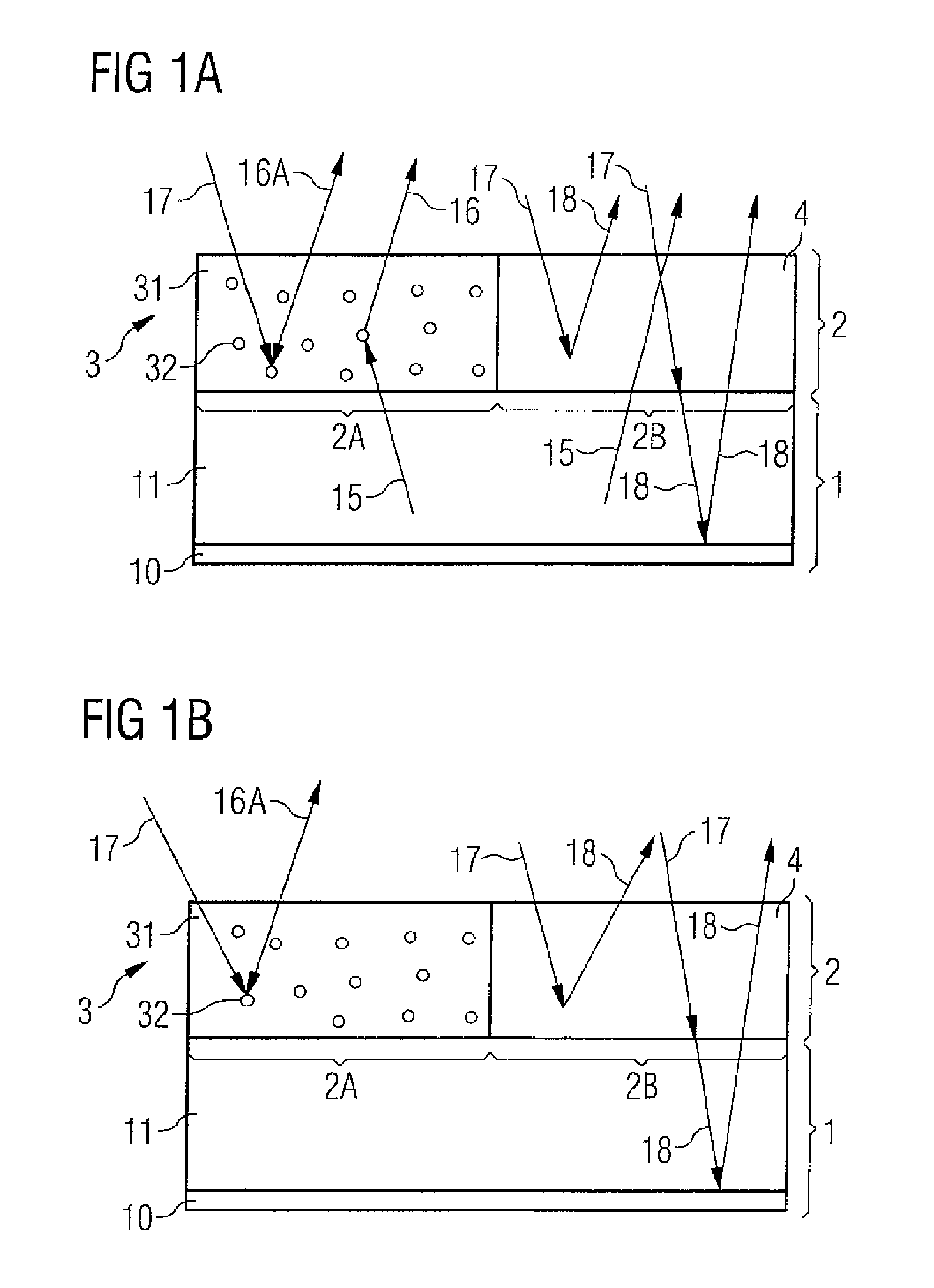
US 8,314,547 (Opto-electronic component) starts from a German application with a priority date of September 19, 2007. Its aim is unusual. A patterned structure layer sits on top of the OLED; one region holds a wavelength conversion layer that changes the wavelength of the light, and another region holds a filter layer that blocks the converted wavelength. Why do it that way? The specification states the object:
“One object of specific embodiments of the present invention is to provide an optoelectronic device comprising a wavelength conversion layer, which device can reduce or avoid an undesired color impression in a switched-off state.”
The undesired color comes from outside light converted by the phosphor while the device is off. With a phosphor, the device takes on a yellowish cast from ambient light even when it is switched off. The structure catches that yellow cast with a filter. The applications the specification names are a flashlight for camera-equipped mobile phones and illumination devices. Not displays.
The drawings make the structure clear at a glance. The specification states explicitly that FIG. 1A shows the device during operation and FIG. 1B in the switched-off state.
US 11,828,425 (Organic-light emitting diode) uses a structured emission exit surface to gather light in one direction, for example by lining up prisms side by side. Encapsulation structures such as thin-film encapsulation and glass frit are added to it. The applications the specification names are luminaires, lighting integrated into a shower cubicle, awnings, and alarm-clock-style lighting.
Pictiva argued that structures written for lighting also read on display panels, and the jury accepted that for these two patents.
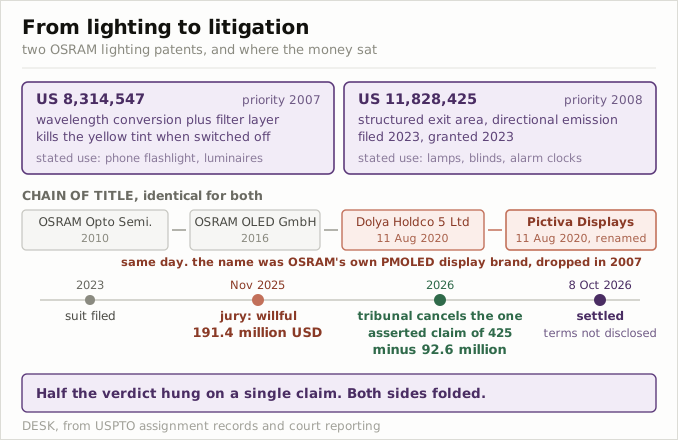
August 11, 2020: a name change the same day
How the patents crossed from a lighting company to a litigation company is recorded in the assignment history. Both patents followed the same path.
| Date | Owner |
|---|---|
| November 23, 2010 | From the 3 inventors to OSRAM Opto Semiconductors GmbH |
| January 21, 2016 | To OSRAM OLED GmbH |
| August 11, 2020 | To Dolya Holdco 5 Limited |
| August 11, 2020 | To Pictiva Displays International Limited (change of name) |
The last two rows carry the same date. Dolya Holdco 5 Limited changed its name to Pictiva on the very day it received the patents. In other words, it was a company set up to hold them.
Pictiva is the name of the display brand OSRAM shut down
Where that name came from is the strangest part of the case.
On July 30, 2007, OSRAM Opto Semiconductors announced that it would end production of passive matrix OLED displays at the end of that year. It would stop the display line in Penang, Malaysia, transfer the 270 employees there to other work, and, in its words, “concentrate exclusively on the core business of lighting.”
The brand name of the display products it shut down then was “Pictiva.”
13 years later, in 2020, the holding company that took over the company’s OLED lighting patents took that very name: Pictiva Displays International.
And the priority date of US 8,314,547 is September 19, 2007. It was filed two months after the company said it was leaving displays to focus on lighting. A lighting patent written on the way out of displays, through a company bearing the name of the shuttered display brand, bit a display maker 16 years later.
A patent granted in 2023 on a 15-year-old priority
US 11,828,425 has one more thing worth noting. Its priority date is December 11, 2008, but it was filed on January 18, 2023 and granted on November 28, 2023.
The owner kept the priority chain alive through continuing applications and obtained a new grant in 2023. That is a lawful procedure and not a rare one. The result is still worth noting: a patent rooted in an application from 15 years earlier was granted in 2023, and a suit was brought on it. The first suit, however, was filed in October 2023, before this patent’s November 28 grant date, so which suit ‘425 entered can only be settled by the court record.
US 8,314,547, from the same portfolio, has an anticipated expiration date of September 6, 2028. The 2007 filing has not yet run its 20 years.
One claim held half the money
To understand the settlement you have to look at what happened after the verdict.
The PTAB cancelled one claim of US 11,828,425. That claim was the only claim of the patent asserted for infringement. Once it fell, the infringement case on that patent could not stand at all.
In money, that is $92.6 million. If the decision is upheld on appeal, that amount comes off the $191.4 million, leaving about $98.8 million.
Both sides had something to lose. Samsung could have paid the full $191.4 million, and Pictiva could have lost half. With willful infringement on the record, Samsung’s risk even included room for the amount to grow. In that position, both sides folded. The settlement terms were not disclosed.
What display companies should read here
Three structures in this case can repeat.
First, a company that exits a business leaves its patents behind. OSRAM withdrew from OLED lighting, but the patents run out their terms. US 8,314,547 is alive until 2028. The patents of a shuttered business become the most dangerous assets precisely because there are no longer any products in that field to defend. There is no card to trade in a cross-license.
Second, a different application does not help if the structure is the same. The argument that a wavelength conversion layer and filter layer, and a structured exit surface, written for lighting also read on display panels got past a jury. Patents are read by their claims, not by their applications.
Third, a single claim can hold half the money. This time, invalidating that one claim worked. Running PTAB proceedings in parallel with the litigation changed the terms of the settlement.
What remains
Here is what has not been confirmed.
We could not identify the numbers of the 3 patents found not infringed. Lists of candidate patents Pictiva asserted appear in several sources, but which of them were found not infringed in this suit has to be confirmed from the court record.
We could not confirm the number of the claim the PTAB cancelled or the PTAB case number either. Reports go only as far as “one claim.”
Case numbers differ between sources. With two suits, they may each be correct, but we could not cross-check them, so they are not given in the text.
The settlement terms were not disclosed. Neither the amount nor whether a license is involved is known.
We could not confirm the date on which the PTAB cancelled the claim. We can confirm only that it was after the verdict.
Why the holding company chose that brand name is not confirmed by any record. We confirmed only that it is the same as the name OSRAM used.
We did not include drawings of US 11,828,425. There are 61 published drawing sheets, and the passage of the specification describing the prism structure gives no figure number, so we could not pinpoint which sheet shows that structure. Picking one by guesswork would attach the explanation to the wrong drawing.
Outlook
This case is over, but the same ground is not empty. The 3 OSRAM portfolio patents found not infringed remain, and US 8,314,547 is valid until September 2028. Because the settlement terms were not disclosed, we cannot even tell whether a license was involved.
There are two points to watch.
First, whether the PTAB’s cancellation decision is upheld on appeal. The settlement closed the suits, but the decision itself sets the value of US 11,828,425 in other disputes. If it is upheld, suing on this patent again becomes difficult.
Second, whether patents from shuttered OLED lighting businesses move again. OSRAM is not the only company that tried OLED lighting in the 2010s and pulled back. Where a company sent its patents when it closed a business becomes the starting point of the next dispute. The assignment records are public and can be read in advance.