Cover simulation A to-scale 3D model of moth-eye nanocones, from Teker's piece. Bumps smaller than the wavelength of light turn the air-to-resin refractive-index change from a step into a ramp, erasing the reflection.
This issue's lead
Apple's Taptic Engine Patent Loss: $5.7 Billion
Apple beat the infringement claim at trial by arguing its Taptic Engine's Q-factor exceeds the 1.5 line the district court had drawn — the appeals court threw out that line for having no basis and reversed. A jury ordered Apple to pay $5.72 billion (about ₩7.75 trillion) in damages.
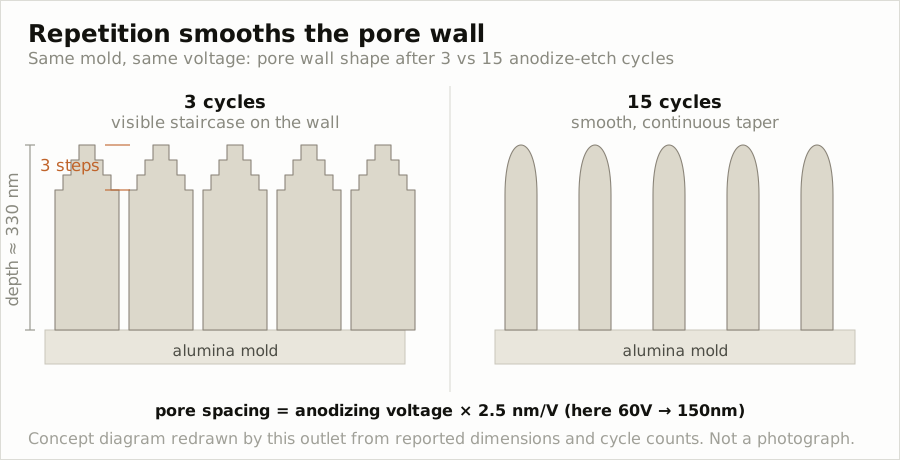
Moth-eye fills the missing refractive index of 1.23 with shape instead of material. Even when bump height is identical, a different profile can split reflectance by a factor of two, and that profile is set entirely by the voltage and etching used to carve the mold. But the same nanoscale gaps trap fingerprint oil that a dry cloth cannot wipe away, so the technology has settled not on the outside of a screen but in places hands never touch.
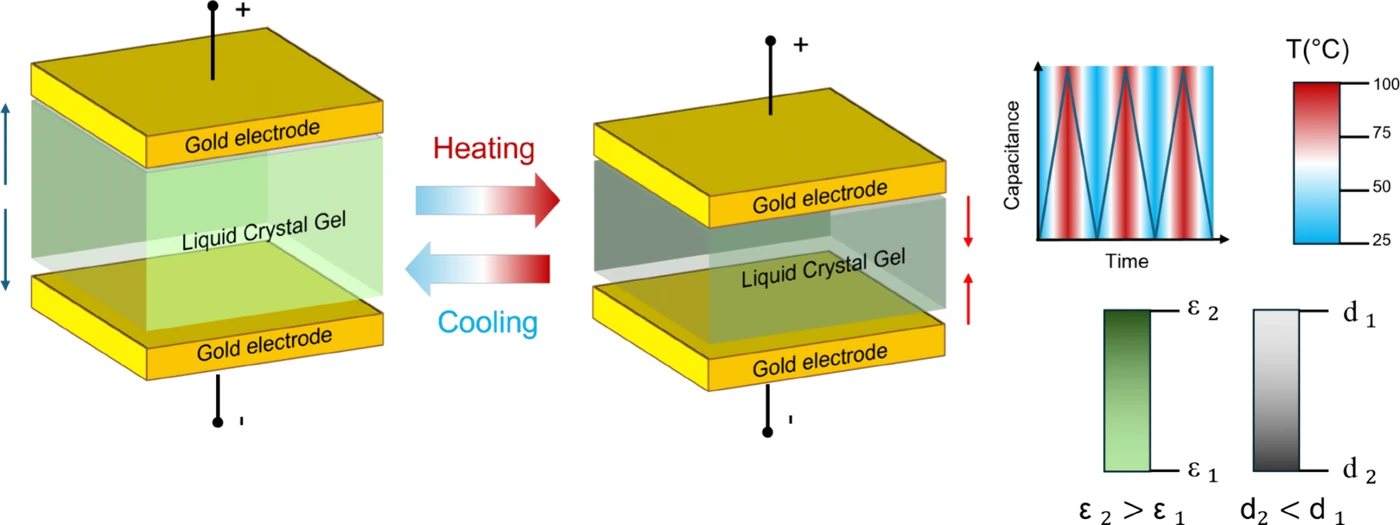
Liquid crystals are highly sensitive to temperature — a property displays have spent decades trying to erase. An Italian team turned that sensitivity into a signal, building a capacitive sensor with a liquid-crystal gel dielectric fabricated on ordinary LC panel-line equipment, one that kept working submerged in water and bent. What set sensitivity apart wasn't how much liquid crystal was loaded, but the phase it was in when cured.
From September 20 to 27, 1,220 papers published in 28 major journals were checked and narrowed to 119 with a display connection, of which 15 are briefly introduced here. Two more are covered as separate in-depth articles. This window brought together the process of making pixels and the problems that show up when pixels are made smaller.
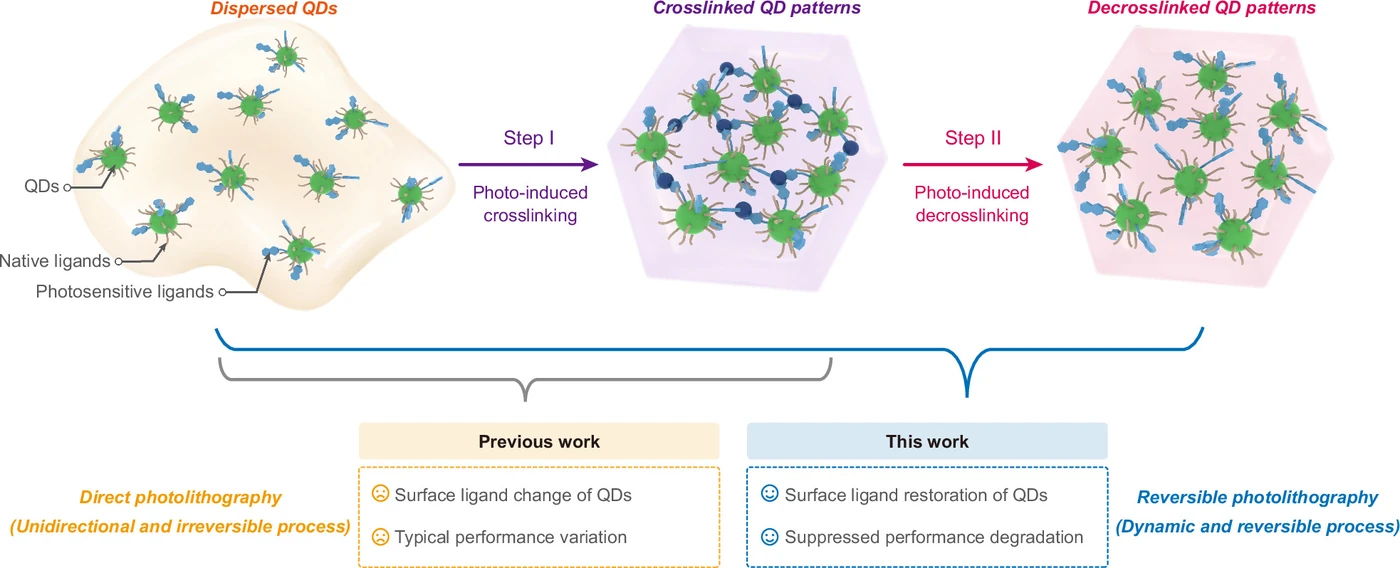
Turning quantum dots into pixels means locking their surface ligands together, and that locking is exactly what erodes device performance. Researchers at the Ningbo Institute of Materials Technology and Engineering, Chinese Academy of Sciences, built a ligand that a wavelength of light can lock and later unlock, restoring the surface after patterning is done. The result is 21,000 pixels per inch with an external quantum efficiency of 17.08%. Look at the tables side by side, though, and what patterning actually cut was not efficiency but current.
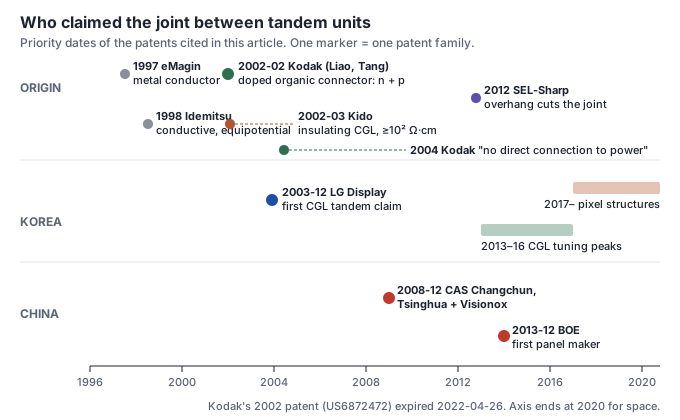
The charge generation layer (CGL) that links emission units in a tandem OLED traces its architecture to a 2002 Kodak patent, which expired in 2022. Korea's two panel makers spent 2013-16 refining the CGL material itself, then shifted after 2017 toward pixel-level structure — and on the shared problem of current leaking sideways into neighboring subpixels, Samsung cuts the CGL apart while LG pins its potential in place instead. China, starting 10 years later, is now claiming both stages of that progression at once.