
Surface treatment: Moth-eye
Moth-eye fills the missing refractive index of 1.23 with shape instead of material. Even when bump height is identical, a different profile can split reflectance by a factor of two, and that profile is set entirely by the voltage and etching used to carve the mold. But the same nanoscale gaps trap fingerprint oil that a dry cloth cannot wipe away, so the technology has settled not on the outside of a screen but in places hands never touch.
The AR/LR episode found that the target refractive index for anti-reflection is 1.23 — the geometric mean of air at 1.00 and glass at 1.52 — and that no dense solid ever reaches it. LR filled that gap with holes, AR filled it by stacking layers.
Moth-eye fills that gap with shape instead of material. Raise bumps smaller than the wavelength of light on a surface, and from light’s point of view the refractive index turns from a step into a slope. Since it never meets a boundary, there is nowhere for it to reflect.
The name comes from the moth’s eye. The structure was inspired by the bumps on a moth’s cornea, which erase the reflections that would otherwise interfere with its night vision. This episode looks at how that shape is made, how far it has gone, and why it stopped where it did.
What moth eyes lend is a gradient in refractive index
The cornea of the oleander hawk-moth (Daphnis nerii) carries bumps 140 to 165 nanometers in diameter, spaced about 166 nanometers apart, packed tightly in a hexagonal array. That size is no accident. It has to be smaller than the wavelength of visible light (380 to 780 nanometers), so that light cannot see the individual bumps and instead sees only the average refractive index of the whole medium.
As a bump widens from its pointed tip down to its base, the proportion of air mixed with resin at that height also grows from tip to base. The refractive index light sees follows that ratio, climbing smoothly from 1.00 up to the resin’s value (about 1.5). If the 1.23 in the AR episode was a single material, the 1.23 of moth-eye is just one point on a slope.
There is one more condition for light to feel this slope as continuous rather than stepped. The spacing between bumps must be narrower than the shortest wavelength of visible light. If the spacing exceeds the wavelength, light diffracts and leaks sideways, and that loss eats into transmittance in a way different from reflection.
This is where it parts ways with the interference stacks of the AR episode. Interference cancels two reflections tuned to a specific wavelength, so reflection comes back once the wavelength drifts off that target. A slope does not discriminate by wavelength. As long as the refractive index changes continuously, both short and long wavelengths lose their place to reflect, for the same reason.
Voltage sets the hole spacing, etching sets the hole shape
The mold that stamps out these bumps is made by anodizing aluminum. Dip aluminum in acid and apply voltage, and hexagonally arrayed holes drill themselves into the surface. The spacing between holes is proportional to the voltage. It widens by about 2.5 nanometers per volt.
This is why a single voltage can produce 100-nanometer-class structures over a large area. There is no need to draw a pattern point by point the way photolithography does. When Sharp launched its moth-eye TV, it likewise led with this voltage control, explaining that the structure “forms itself over a large area.”
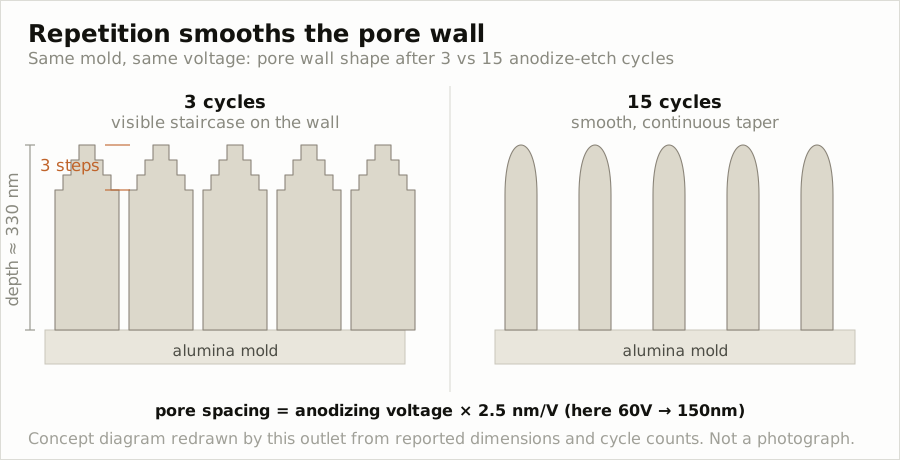
If voltage sets the spacing, the number of repetitions sets the shape. Going through the process of drilling a hole by anodizing once and then widening it with phosphoric acid just once leaves a step on the hole wall. That step is what separates a sharp cone from a gentle bell shape.
The same study repeated this anodizing-and-etching cycle up to 15 times. As the repetitions grew, the height of each individual step fell, and the hole wall approached a smooth curve. The final mold had a hole spacing of 150 nanometers, and the stamped-out bumps stood 330 nanometers tall.
The way the industry pins this shape down as a specification tells the same story. A Mitsubishi Rayon patent sets its fingerprint test by pressing 1 microliter of JIS K2246 artificial fingerprint fluid with a 10-millimeter-diameter rubber stamp at 100g/cm² for 3 seconds, then passing if it wipes off in 2 wipes or fewer. Abrasion resistance is tested by dragging steel wool (Bonstar #0000) back and forth 10 times under a 100g load, passing if 4 scratch lines or fewer appear. Anti-reflection performance is not measured by a single spec — how well it holds up is written into the spec right alongside it.
Another reason this process makes moth-eye special is cost. A 2013 SID commentary summed up anti-reflection technology as a whole this way: LR (single-layer coating) is cheap but its reflection is not low enough, and AR (multilayer deposition) has low reflection but a high production cost. Moth-eye stamps out a single layer of UV-cured acrylic, yet optically it behaves as if many layers had been stacked. It is, in effect, aiming for AR-level performance with LR-level process.
Same height, so why does reflectance differ?
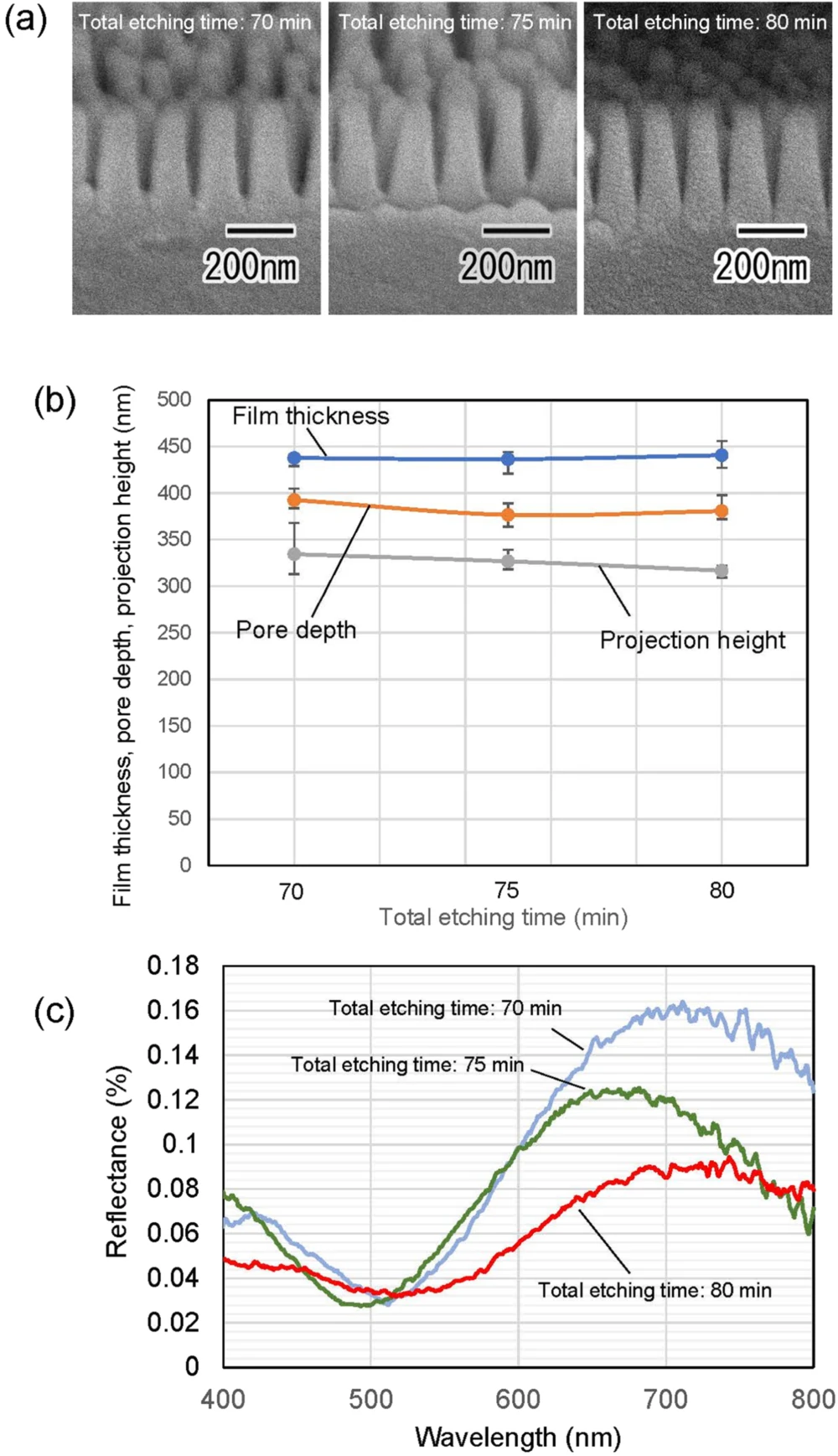
Because it is the shape of the bump that sets reflectance — not the height. The same study made three samples that differed only in etching time — 70, 75, and 80 minutes — and all three came out with bumps at nearly the same height, around 320 nanometers.
| Total etch time | Bump height | Reflectance, 400-800 nm |
|---|---|---|
| 70 min | ~320nm | Rises to 0.13-0.15% at long wavelengths |
| 75 min | ~320nm | Rises to around 0.12% at long wavelengths |
| 80 min | ~320nm | Flat at 0.04-0.09% across the whole range |
The heights are the same, yet the 80-minute sample’s reflectance is about half that of the 70-minute sample. The longer the etching runs, the more the steps on the hole wall are erased and the smoother the curve becomes. The smoother the shape, the smoother the refractive-index gradient, and the smoother the gradient, the less it reflects.
The effect of shape shows up in the same direction even when the bump profile itself is changed. A study that compared cones and paraboloids by simulation found that the paraboloid reached the same reflectance at a lower height than the cone. That is because the refractive index changes along a gentle curve rather than a straight line.
The same study calculated that the degree to which the bases touch each other (base diameter divided by bump spacing) needs to be 0.7 or higher. If a flat floor is left between bumps, the refractive index drops there in a step and reflection reappears.
Bump spacing has a limit on the other side too. If the spacing widens past 400 nanometers, it exceeds the shortest visible wavelength and diffraction appears in place of specular reflection. Widen the base to raise the fill fraction and cross that boundary, and while reflection falls, another kind of loss grows. Smaller bumps are better, but they cannot be made infinitely small.
In the simulator below you can change the bump shape, the degree to which the bases touch, and the height yourself, and see how predicted reflectance responds.
Lower the degree to which the bases touch, or switch the bump shape to a cone, and you can watch predicted reflectance rise noticeably. It matches the measured value (0.13% for the paraboloid) in order of magnitude, but that is exactly as far as this model’s precision goes.
Lost in the transfer: the window that temperature and speed open
Even after the mold is finished, the shape still has to be transferred onto film intact. An experiment stamping bell-shaped bumps (spacing 290 nanometers, mold height 350 nanometers) onto PMMA (glass transition temperature about 105°C) by roll-to-roll thermal nanoimprint shows this window.
| Temperature | Speed | Result |
|---|---|---|
| 80-100°C (below Tg) | 0.02 m/min | Only an indentation forms, about 90-280nm deep; no bump rises |
| 110-140°C (above Tg) | 0.02 m/min | Bumps rise and top out around 300nm; 140°C is the most faithful |
| 110°C | 0.2 m/min | The bump that had risen disappears, leaving only an indentation |
Below Tg the resin is set solid, so the bump cannot stand up. Only above Tg does the resin flow enough to fill the mold’s recessed spots — but even then, spin the roll too fast (0.2 m/min) and the resin cannot get enough time before it cools and sets, so the same thing happens. Temperature and speed have to sit inside the same window together.
The higher the aspect ratio (height divided by spacing) climbs, the narrower this window gets. In the same study, the high-aspect-ratio structure showed apparent stiffness up to 50% lower than a flat film, and in nanoscratch testing the indentation grew from 20 nanometers to around 50 nanometers.
A Mitsubishi Rayon (now Mitsubishi Chemical) patent pins this window down in numbers. If the bump aspect ratio is 1.0 or above, reflectance drops low enough; if it is 5.0 or below, it withstands scratching. Between the floor reflectance demands and the ceiling durability demands, 1.5 to 3 is where actual commercial products cluster.
Why can’t it survive a single fingerprint?
It is the same physics seen in the AR/LR episode. The design assumes the gaps between bumps are filled with air, and once oil seeps into those gaps the refractive-index gradient disappears. What is different here is that the channel the oil seeps through is a hole narrow enough to be measured in nanometers.
A Mitsubishi Chemical developer put it this way: “Once a fingerprint lands, the oil from skin gets trapped in the texture. It is hard to wipe off with a dry cloth, and water or alcohol is needed.” The narrower the gap, the stronger the capillary force pulling the oil in, and the fibers of a dry cloth cannot overcome that force.
Water-repellent treatment looks like the answer, but it is not. The example table in a Dexerials patent shows exactly why. The resin formulation was varied to lower the water contact angle step by step, and wipe-off was graded at each step.
| Water contact angle | Dry-cloth wipe-off | Wet-cloth wipe-off |
|---|---|---|
| 111.1° | C (fails) | fails |
| 109.0° | A | B |
| 107.0-50.7° | A | A |
| 23.4-15.7° | B | AA (very easy) |
| 10.3-4.0° | C | AA |
Both ends are blocked off. Above a contact angle of 110 degrees, even a wet cloth cannot wipe it off, and make the resin too soft (contact angle in the 10-degree range) and, conversely, a dry cloth cannot wipe it off either. The window this patent claims is an elastic modulus of 5 to 1,200 megapascals with a contact angle of 110 degrees or below, preferably 30 degrees or below.
There is also a result from pushing water repellency even further. A Sharp anti-fouling-coating patent raised the surface fluorine ratio above 33 atomic percent, pushing the water contact angle up to 158-164 degrees. But drop oil (hexadecane) on that same sample and the contact angle collapses — 66-86 degrees right after landing, falling to 31-75 degrees 10 seconds later.
It repels water, but oil cannot hold for even 10 seconds. This is why the industry has leaned toward designing moth-eye as hydrophilic (water contact angle in the 10-30 degree range) rather than water-repellent. Mitsubishi Chemical’s MOSMITE having a water contact angle of about 20 degrees appears to be the result of the same judgment.
There is also an approach that changes the wiping tool instead of the surface treatment. A Fujifilm patent confirmed that even with water-repellent treatment (oleic acid contact angle 113 degrees) fingerprint wipe-off stayed at grade B to C, and instead paired it with a nanofiber cleaning cloth with pore diameters of 50 to 200 nanometers. Only the sample that used both the water-repellent coating and the dedicated cloth together reached wipe-off grade A. It means the surface alone cannot solve this — the surface and the wiping tool have to be designed as a pair.
So where has this technology actually landed?
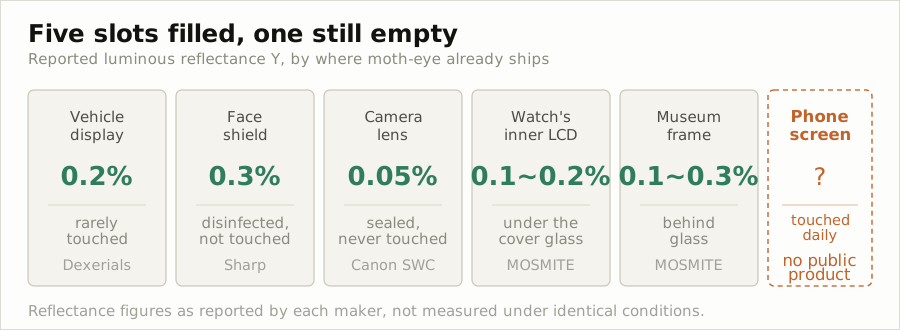
It moved to places hands do not touch. The Mitsubishi Chemical developer’s own words are the conclusion of this episode as well: “The initial target was large TV displays, because adoption there means scale. But the screen is a place that gets touched constantly, so in the end we narrowed our direction toward places people do not touch, or the inside of the display.”
Dexerials’ moth-eye film product page carries that same judgment as a warning: “Due to its structural nature, the moth-eye film cannot completely remove surface stains. It is not recommended for parts that hands or contaminants touch frequently.”
The same company’s product lineup proves that warning outright. For mobile-device touch panels, it sells not moth-eye but sputtered multilayer AR — the structure covered in the AR/LR episode. That product carries a separate anti-fouling layer so fingerprints wipe off easily.
| Product | Structure | Photopic reflectance | Application |
|---|---|---|---|
| Dexerials ME1 | Moth-eye | 0.2% | Automotive displays |
| Dexerials AR200 | Sputtered multilayer + anti-fouling layer | 0.18-0.32% | Tablet/notebook touch panels |
Even the closest case did not reach the outside of a screen. Mitsubishi Chemical’s MOSMITE was fitted onto the Casio G-SHOCK GBD-H1000, but it went not onto the cover glass hands touch, but onto the solar cell element and the LCD module surface. Nokia filed a patent for a moth-eye structure on phone screens back in 2003, but it never reached registration and was withdrawn in 2012.
Apple has come closest to a screen hands actually touch. The nanotexture glass on the Studio Display, Pro Display XDR, iMac, MacBook Pro, and iPad Pro (M4) is, by Apple’s own patent, a two-tier texture. Large texture 750 nanometers to 25 micrometers wide and 200 nanometers to 2 micrometers tall scatters light, and on top of it, small texture 5 to 200 nanometers in width and depth lowers the effective refractive index to suppress reflection. But this large texture is closer to an AG that scatters light — it is not a structure that erases reflection with a single refractive-index gradient the way moth-eye does.
This screen, too, cannot be maintained without a dedicated tool. Apple instructs cleaning only with the dedicated polishing cloth that ships with the product, and restricts using a 70% isopropyl alcohol solution on that cloth to stains that will not come off otherwise. A different company arrived, by a different route, at the same conclusion the Fujifilm patent reached by designing the surface and a dedicated cleaning cloth as a pair.
Corning Gorilla Armor, on the Samsung Galaxy S24 and S25 Ultra, takes the opposite approach — it cuts reflection not with a nanostructure but by changing the glass-ceramic composition itself. Gorilla Armor 2 is stated to be more than four times as scratch-resistant as the previous generation’s competing AR-coated products. Today’s flagship smartphones are still looking for their answer on the material and coating side.
Why automotive displays became moth-eye’s home shows up in numbers too. According to Dexerials, an ordinary film surface reflects about 10 percent, and applying moth-eye film drops that to 0-1 percent, with steel-wool abrasion resistance stated at more than 40 times an ordinary film. A screen facing the driver’s seat is rarely touched by hand and the cabin temperature is relatively stable, so the conditions moth-eye has to survive there are milder than on a phone.
Right now moth-eye is actually deployed in places like automotive navigation and instrument clusters, museum picture frames, medical and quarantine shields, camera lenses, and anti-fog sheets for diving and ski goggles — mostly environments where hands never touch it directly, or where it is cleaned on a regular schedule. Application to camera filters is also reported to be under development. A technology that started with large TVs ended up settling on the opposite end.
Moth-eye for lenses is, if anything, the place it has survived longest. An aluminum-oxide wedge-shaped nanostructure coating Canon filed in 2008 pushed reflection down to about 0.05 percent with a height of 220 nanometers. A lens is, from the outset, something hands do not touch and that presumes regular cleaning, so moth-eye’s weakness was never a weakness there to begin with.
“A place hands don’t touch” does not mean “a weak technology.” A moth-eye structured film Sharp jointly verified with Nara Medical University (surface reflectance about 0.3% per face) lowered the infectivity of the novel coronavirus by 99.675% at 10 minutes and 99.968% at 30 minutes. Even after 100 wipes with alcohol, the 30-minute reduction rate held at 99.959%, essentially unchanged. What is fragile is not the structure itself, but wiping oil off with nothing but a dry cloth.
The way back: hydrophilic and inverted structures
Change the shape, and the situation changes. Research that digs holes (nanoholes) instead of raising bumps (nanopillars) shows this possibility. In the experiment, fingerprints were applied to both a bump structure and a hole structure of the same size, and wiped five times in a row.
When the fingerprint first lands, transmittance drops 15 percent on both, with no difference between them. But after five repeats they diverge. On the bump side, transmittance falls more than an additional 1.5 percent and the peak transmission wavelength shifts as well, while on the hole side it stays nearly unchanged, under 0.2 percent. A bump gets pressed down or bent out of its original shape in the course of wiping, but a hole is held up by its own walls.
There is also a route of hardening the structure with a coating. In a study that sputtered TiO2 at 50 and 100 nanometers onto PMMA bumps, the uncoated sample was pressed down nearly 100 nanometers even under a very weak force (0.2mN), while the sample with a 100-nanometer coating held elasticity equal to a flat film even under a force five times stronger (1mN).
It is not free, though. The thicker the coating, the thicker the bump base grows and the narrower the gaps become, and transmittance near 600 nanometers drops by around 1 percent. There is also a calculation that says the coating should be built into the design from the start, rather than added afterward. If a coating is assumed from the outset, the degree to which bumps touch each other needs to be lowered from 100 percent to 60 percent to get the optimal gradient. Which means a mold designed for a coating is not yet the same as a mold without one.
There is even a route that takes no loss at all. But it has to be a hole, not a bump. A study that coated nanoholes cut into glass with an ultrathin oleophobic coating carrying a silane group (a molecular-scale thickness) reports that the coating did not change the transmission or reflection spectrum at all. Optical performance stayed unchanged even after an abrasion test (cotton cloth at 7.35 newtons pressure, 1,000 back-and-forth passes). With a coating as thick as TiO2’s (50-100 nanometers), optics and durability have to be traded off against each other, but once the coating is as thin as one or two molecular layers, that trade-off itself disappears. The same words, “apply a coating,” produce different results depending on a single order of magnitude in thickness.
In a similar spirit to the hole (nanohole), there is also an approach that inverts the bump into a shape recessed inward (an inverted cone). A roll-to-roll imprint study reported that the inverted-cone structure withstands higher mechanical stress than a protruding cone while not losing much anti-reflection performance. It amounts to shaping the profile for reflectance and then flipping it again for durability.
There is also an approach that makes the structure itself doubled. A Sharp patent fills the bottom half of a first set of bumps with a low-index fluoropolymer (CYTOP, refractive index about 1.32), creating a second, lower and gentler texture on top. Even at these lowered bump heights (185, 210, 280 nanometers), reflectance held at 0.059%, 0.057%, and 0.031% respectively. As the patent explains, once the gaps between bumps become shallower, scraping out trapped contamination gets that much easier too.
Erase reflection with shape, endure contamination with hydrophilicity or a double texture, survive abrasion with holes or a coating. Most of these branches remain either at the laboratory stage or confined to narrow applications. There is a 2025 study that made a mold at phone-screen size (14.5 by 10 centimeters), but the authors themselves wrote it up as a possibility, not mass production. The path for moth-eye to return to the outside of a screen will likely lie not in any single one of these branches, but at the point where several of them are satisfied at once.
The next episode looks at how static charge and other contamination interact with the anti-reflection layer on the same cover window.