
Surface treatment: HC (Hard Coating)
A hard coat does a different job on every substrate. On film it lends hardness to a soft base and fights curl; on automotive PC it is graded by Taber haze instead of pencil hardness; on UTG it takes pen drops as a layer softer than the glass. Even a pencil hardness of 9H cannot be compared unless the load and the substrate are written down with it.
Wipe a screen with sandy hands and fine scratches are left behind. Carry keys in the same pocket, though, and a glass screen usually comes out fine. What decides the difference is whether the scratching side is harder than the side being scratched.
If the top of the screen is plastic, it stands far down that order. That is why a hard coat (HC) goes on top. But although the name is the same, the material, the way it is cured, the report card and the way it fails all differ with the substrate.
This episode sets four substrates side by side for each question: film, molded plastic, ultra-thin glass (UTG) and tempered glass. What is it made of, how is it cured and bonded, what is it graded by, and where does it fail?
Scratching is decided by the order of hardness
Only particles harder than the screen cut grooves into it. Quartz, the main component of sand, has a Vickers hardness of 1,070HV, about 10.5GPa. Ion-exchange strengthened cover glass has a nanoindentation hardness of about 8.3GPa. Quartz sits one rung above.
When Corning filed for scratch-resistant glass, it wrote that ion exchange raises surface strength but barely raises hardness. Glass still gets scratched by anything harder than itself. Strengthening is a treatment against breaking, not against scratching.
A hard coat on plastic sits much further down this ladder. A coating for flexible displays published in Nature Communications in 2024 exceeded 7H pencil hardness at 750g on CPI. Yet when the same coating was made 200 micrometers thick to remove the substrate’s influence and measured by nanoindentation, it came to 0.29GPa. That is about 1/30 of glass.
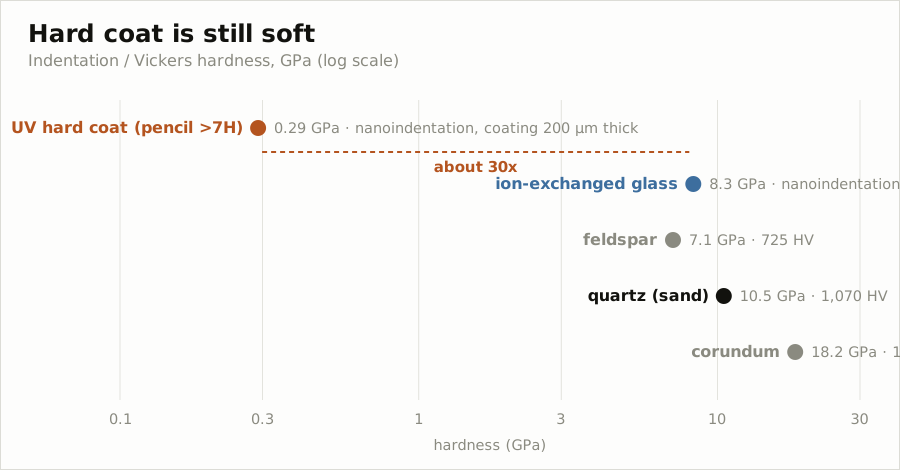
So a hard coat does not turn plastic into glass. On each substrate the hard coat has its own job. Before getting to that, we need to look at the number that always comes up when hard coats are discussed.
What does 9H measure?
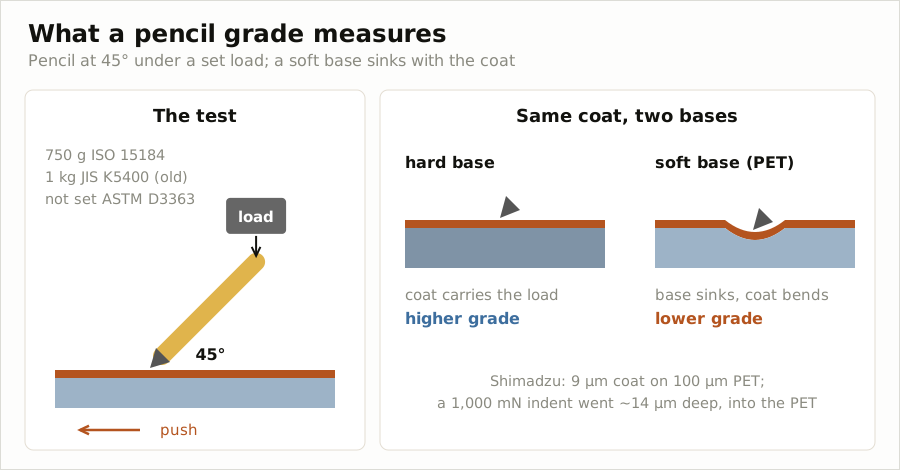
Pencil hardness is the hardest pencil whose lead, drawn at 45 degrees under a set load, leaves no mark. Because the load differs by standard, a 9H written without its load cannot be compared with another 9H.
| Standard | Load | Notes |
|---|---|---|
| ISO 15184 · JIS K5600-5-4 | 750g | Cart required; tested upward starting from 6B |
| JIS K5400 (old standard) | 1,000g | Replaced by the current JIS K5600 but still used in patents |
| ASTM D3363 | Not specified | Gouge hardness and scratch hardness judged separately |
In a foldable cover window patent, LG Display listed the pencil hardness of the same hard coat layer by load. At 750g it was 4H, at 500g 6H, and at 250g 8H. Cutting the load to 1/3 raised it by four grades.
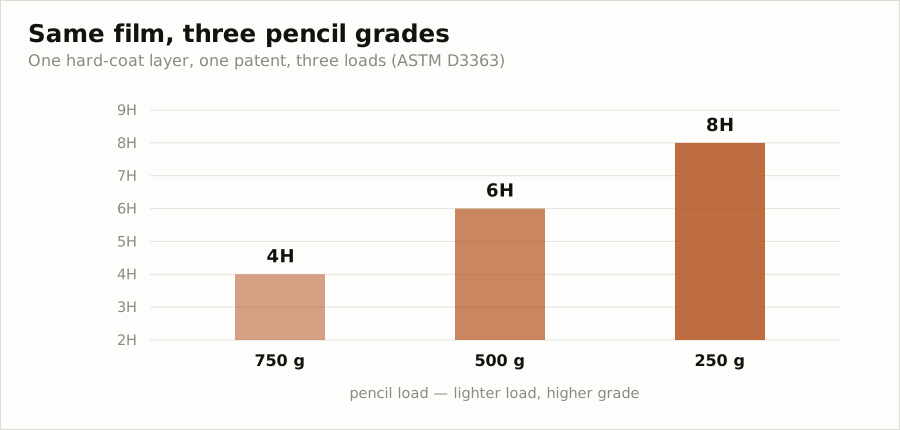
Sometimes the standard’s name alone does not tell you the load. BenQ Materials wrote in its patent that pencil hardness was measured per the test “specified in JIS K5400,” yet measured it at 750g. LG Chem cited the same JIS K5400 and measured at 1.0kg. Under the same standard name, the load differs.
The substrate changes the grade too. When Shimadzu measured a 9-micrometer hard coat on 100-micrometer PET, the indentation depth at 1,000mN was about 14 micrometers, going through the hard coat and into the PET.
Under a pencil load as well, the soft substrate sinks along with it, and the hard coat bends on top of it. Even the same coating gets a lower grade on a soft substrate.
Same name, different materials
The name hard coat is the same, but the resin that goes in differs by substrate. How much heat the substrate can take, how thin it is and what it is made of choose the material.
| Substrate | Typical materials | Thickness |
|---|---|---|
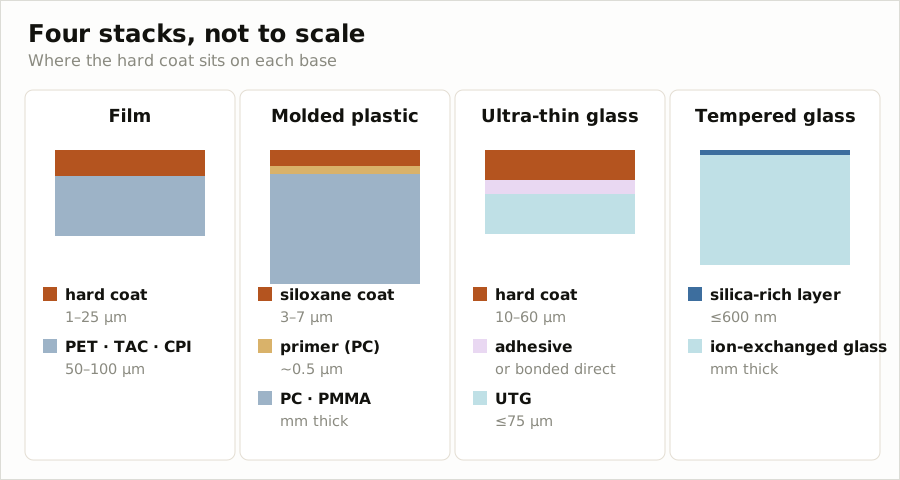
| Film (PET · TAC · CPI) | UV acrylate, silica hybrid, epoxy siloxane | 1-25μm. For 9H, 80 on top and 100μm below |
| Molded PC · PMMA | Thermally cured siloxane, UV silica-modified | 3-7μm. UV types 7-15μm |
| UTG | Urethane acrylate, silsesquioxane | 3-60μm |
| Tempered glass | Treatment of the glass surface instead of a coating | 600nm or less |
Materials on film fall into three broad branches. The first is curing multifunctional acrylates with ultraviolet light. The second is mixing silica nanoparticles into them. 3M filed that a 1-10 micrometer coating containing 30-68 wt% of reactive silica 5-60 nanometers in diameter did not crack under a 4H pencil at 1kg load.
In the same filing, the proportion of reactive groups on the particle surface decided success or failure. Particles whose surfaces were fully reactive were weak when folded, and particles with no reactive groups at all wore away when rubbed. Particles leaving only 1-3 mol% reactive groups handled both at once.
The third is epoxy siloxane. Unlike acrylates, it cures not by radicals but by cationic ring opening. Professor Byeong-Soo Bae’s group at KAIST reported 9H on PET with this family, and hard coat patents from Kolon Industries and LG Chem also use it.
On molded plastic, thermally cured siloxane has long been the mainstream. Momentive’s and SDC Technologies’ hard coats for automotive and exterior parts belong to this family, and the recommended thickness of 3-7 micrometers is thinner than on film.
For headlamp lenses, UV-cured silica-modified coatings are also used. On PC for automotive glazing, a plasma-deposited silicon oxide layer is sometimes added on top of the siloxane.
Even the same “siloxane” cures differently on film and on molded parts. Epoxy siloxane on film cures through cations generated by UV light, while siloxane on molded parts cures over time in an oven.
On UTG, yet another material goes on. Corning used a hexafunctional urethane acrylate, and the Nano and Advanced Materials Institute (NAMI) in Hong Kong used silsesquioxane. We found no public evidence of a micrometer-thick polymer hard coat being applied on tempered glass.
The substrate sets the curing conditions
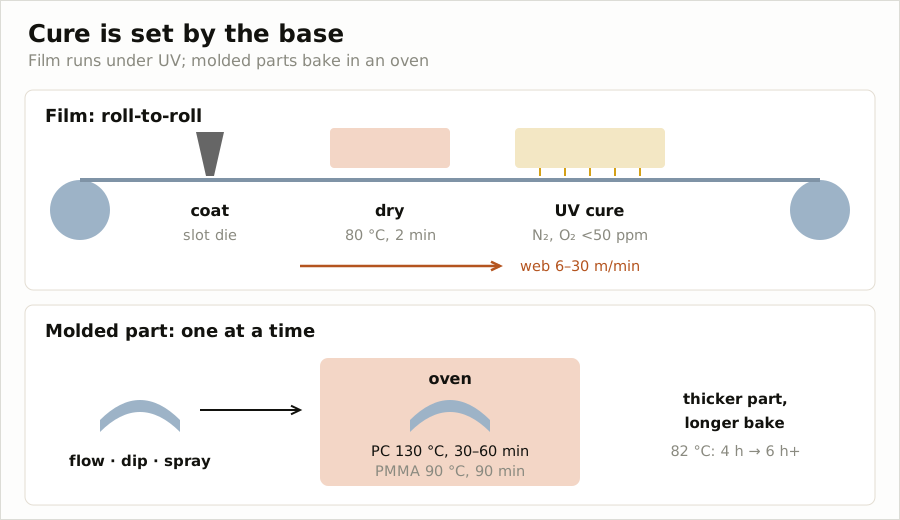
Film cures while flowing under UV light; molded parts are baked in an oven for over an hour. Thin film deforms if heated for long, and for thick molded parts the baking time is set by part temperature.
Film cures as it flows roll-to-roll. In BenQ’s worked example, solvent was driven off in an 80℃ oven for 2 minutes and the coating was cured with UV at 298mJ/cm². 3M applied it to a PET web by slot die at 6-30 meters per minute.
With acrylates, oxygen in the air inhibits surface cure. So nitrogen is used to push the oxygen out. BenQ cured under a nitrogen atmosphere, and 3M at below 50ppm oxygen.
Molded parts are coated one at a time by flow, dip or spray coating and then placed in an oven. Momentive specifies baking its PC grade at a part temperature of 130℃ for 30-60 minutes and its PMMA grade at 90℃ for 90 minutes. It wrote that to use the PMMA product on PC, it should be baked at 126℃ or above.
The 90 minutes for PMMA is based on a 4mm-thick sheet; thicker parts are baked longer. SDC’s siloxane for PMMA is baked at 82℃ for 4 hours, and over 6 hours for a 1/2-inch sheet.
UV-cured coatings for molded parts also run under different conditions from film. Momentive’s headlamp grade preheats the part surface to 65-95℃ and then exposes it to 3-8J/cm² of UV. By the stated figures, that is more than 10 times the film worked example.
The substrate also sets how it bonds
PC needs a primer. Momentive lays a 0.5-micrometer primer under its siloxane for PC and lists its three roles as hard coat adhesion, water resistance and UV resistance. The PMMA grade bonds without a primer.
With UV-cured types, instead of a primer the coating soaks into the PC surface and forms an interpenetrated layer. Momentive lists the recommended thickness of this layer as 1.5-5.5 micrometers, separately from the hard coat thickness.
UTG splits in two. In Corning’s patent, the hard coat is attached on a transparent adhesive layer on top of the UTG. NAMI wrote that, without an adhesive layer, the silicon-oxygen backbone of silsesquioxane bonds directly to the glass surface. Glass is a silicon-oxygen backbone too.
The test that asks whether it has stuck is similar regardless of substrate. A cross-hatch is cut into the coating and pulled off with tape. Momentive’s PMMA grade was at the top rating (GT0) after 240 hours of immersion in 65℃ water, and NAMI claimed 4B or better after 30 minutes in 95℃ water.
Why do molded-part data sheets have no pencil hardness?
Hard coat data sheets for thick PC and PMMA parts, such as automotive display cover lenses and headlamps, often list no pencil hardness at all. That is because the report card differs by substrate.
| Substrate | Report card | Example |
|---|---|---|
| Film | Pencil hardness, steel wool | 9H at 750g · contact angle after steel wool |
| Molded PC · PMMA | Taber haze, weathering hours | Haze increase below 10% after 500 cycles |
| UTG | Pen drop height | 2 times · 4 times bare UTG |
| Tempered glass | Knoop scratch threshold | About 3 times before treatment |
The report card for film bundles several tests on one sheet. Dongwoo Fine-Chem measured a 10-micrometer hard coat on 100-micrometer polyimide in five ways. For pencil, it drew five times at 500g and counted it as a failure if two or more left marks.
For steel wool, it loaded #0000 with 1kg, made ten round trips and counted the scratches. Adhesion was measured by the number of squares left out of 100 cut at 1mm intervals, and curl by the average height of the four corners of a 10×10cm specimen. Bending was checked by folding it in half with 6mm between the faces.
Even the same “curl pass” uses a different yardstick at each company. LG Chem set the best grade as corners under 5mm on a 15×20cm specimen, and Dongwoo Fine-Chem as an average of 20mm or less over the four corners of a 10×10cm specimen. Pencil loads too now include 500g alongside 750g and 1kg.
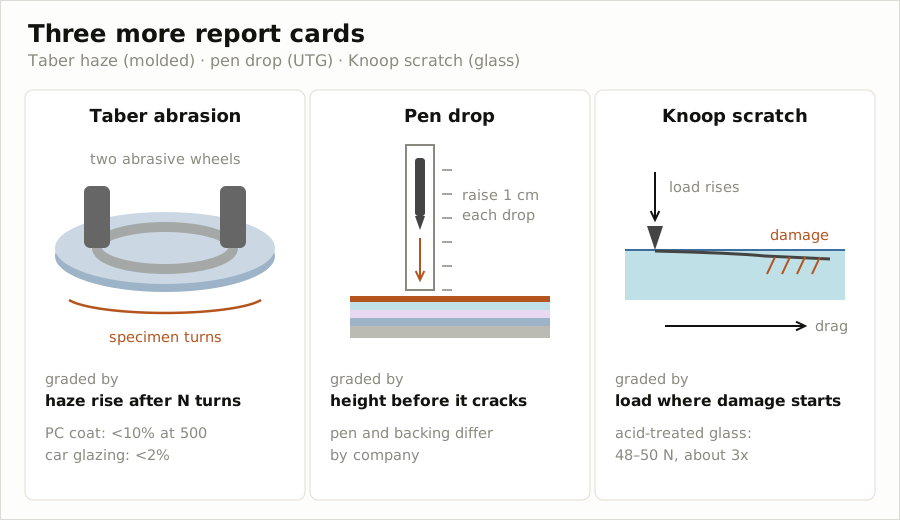
Molded parts are graded by the haze increase after a Taber abrasion test. The specimen rotates under two abrasive wheels, is rubbed for a set number of cycles, and the clouding is measured as ASTM D1003 haze.
Momentive’s PC grade, rubbed 500 cycles with CS-10F wheels at 500g, shows a haze increase below 10%.
The same company’s PMMA grade was 2% at 500 cycles and 5% at 1,000 cycles. Automotive glazing is stricter. In a patent, Exatec gave the US standard for automotive glazing as a haze increase below 2%.
Momentive wrote that baking its PMMA grade longer, for 2 hours, can meet 2% even after 1,000 cycles. Baking time shows up directly on the report card.
Another report card is sunlight. Momentive wrote that its headlamp coating passed 3,000 hours of Renault-PSA xenon weathering and 4,500 hours of Volkswagen PV 3929. SDC reported 100% adhesion even after 3 years of Arizona exposure.
Conditions inside the car are separate. There are measurements showing that a large instrument panel in sunlight reaches surface temperatures of about 75-105℃ depending on location. There is also a separate test that leaves sunscreen and hand cream on the surface at 80℃ for 24 hours.
The report card for UTG is the pen drop. A pen is placed in a tube and dropped from heights raised step by step starting at 1cm, and the height just before cracking is recorded. Corning raised it 1cm at a time up to 20cm and 2cm at a time above that, counting a visible flaw over 0.2mm as a failure.
Corning claimed 2 times or more of bare UTG, and NAMI 4 times or more.
But the two companies dropped different pens. Corning used a 5.73g ballpoint pen with a 0.7mm tungsten carbide ball at its tip, and placed the sample on an aluminum plate with 100 micrometers of PET and a 50-micrometer adhesive layer underneath.
NAMI used a 12g refill with a 0.5mm tip. Each multiple is relative to its own bare UTG, so 2 times and 4 times cannot be compared side by side. Just as 9H needs its load, pen drop needs its pen and backing.
Film curls, molded parts craze
The way it fails also follows the substrate. Thin film is pulled into a curl by the force of the shrinking coating. Thick molded parts do not curl, but craze instead from stress left over from molding.
Film’s problem is curl
Apply a coating that shrinks as it cures to one side of a thin film, and the film curls toward that side. LG Chem wrote in a patent that “the acrylate-based resins have high curing shrinkage, which causes serious curling. Therefore, a double-sided coating or a thin coating is required.” This is the first reason hard coats on film cannot be piled up thick.
The same patent shows the price of 9H on film. The film with which LG Chem achieved 9H at 1.0kg was 230 micrometers in total, with 80 micrometers on the top face and 100 on the bottom of a 50-micrometer PET. The hard coat is more than three times thicker than the film.
A comparative example coated on one side only was also 9H, but the corners of a 15×20cm specimen lifted more than 10mm and it failed the curl judgment. The grade is the same, but coat only one side and the film becomes unusable.
Curl appears even with thin coats. 3M measured that a film with a 10-micrometer acrylic hard coat cured on 75-micrometer PET curled to a 5cm radius. Fujifilm measured the curvature of a 9-micrometer hard coat on 80-micrometer TAC at a similar level.
How much would the same coating curl if only the substrate changed? We calculated it with a bending model for a layered beam. The coating’s cure shrinkage was fitted to 3M’s measurement, and the same value reproduces Fujifilm’s TAC measurement within 4%.
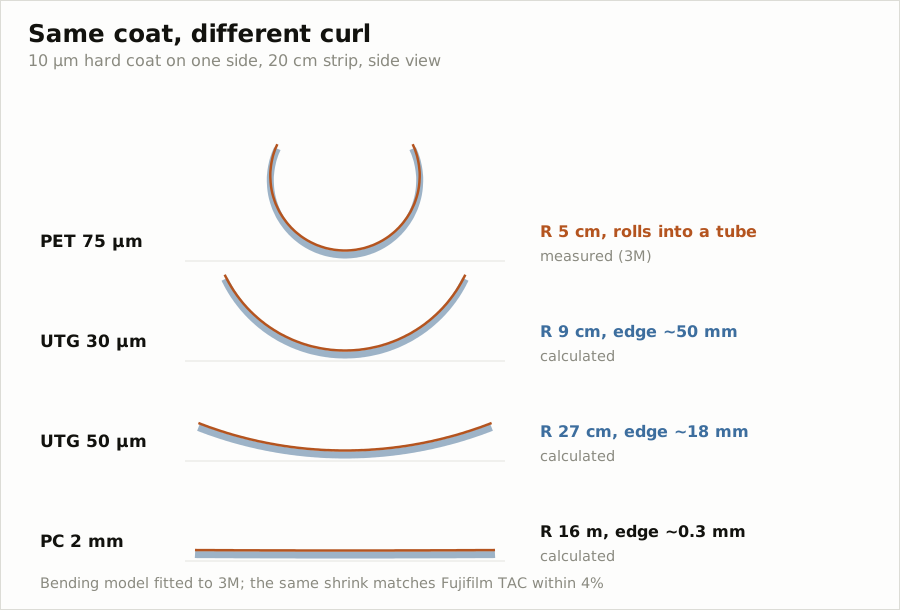
On 2mm PC, the same coating is almost flat. The curvature is about 1/330 of PET. When the substrate is 27 times thicker, bending it becomes harder by the cube of that. This is why hard coats on molded parts do not worry about curl.
On 50-micrometer UTG, the curvature drops to about 1/5 of PET. Even though the modulus of glass is about 15 times that of PET, it is thin enough that it cannot stop the curl entirely. With 30-micrometer UTG, it curls more than half as much as PET. Hard coats on glass are not free of curl either.
Four ways to tame curl
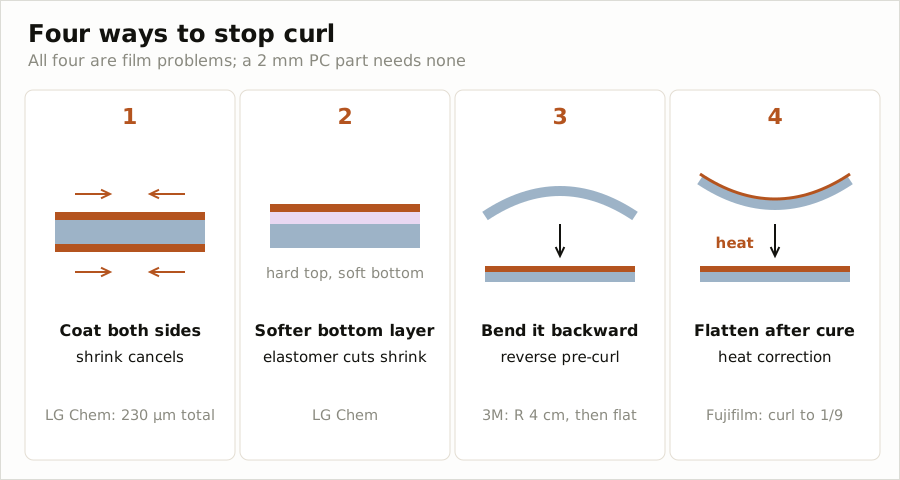
The first is coating both sides. If the top and bottom shrink by the same amount, the two forces cancel and any substrate becomes flat. LG Chem’s 230-micrometer film takes this approach.
The second is making the layer that touches the substrate shrink less. LG Chem mixed an elastomer into the lower layer to reduce how much the epoxy siloxane shrinks as it cures.
The third is pre-bending it the other way before curing. Before coating, 3M bent the PET web in the opposite direction to a 4cm radius. When it was then coated and cured under the same conditions, the film that used to curl to a 5cm radius came out nearly flat in both the length and width directions.
The fourth is flattening it after curing. Fujifilm reduced the curvature of TAC film to 1/9 with a correction process that applies heat to flatten it. All four are effort needed only on film. On 2mm PC, it is flat without doing anything.
The problems for molded parts are crazing and yellowing
Thick sheets barely curl. Instead, crazing is the problem. Apply a solvent-borne coating over stress left from injection molding, and fine cracks appear. Momentive wrote that the initial stress in PC parts should be kept below 1,000psi, and if it is exceeded, the part should be annealed at 130℃ for 30 minutes per 2.5mm of thickness.
The molded-part process also comes with its own cleaning. Momentive wrote that its PMMA grade should be applied in a clean room of class 10,000 or better, with dust blown off by ionized air before coating. Any dust that settles during an hour in the oven cures right in place.
Sunlight turns PC yellow. So UV absorbers are put into the primer and the hard coat. The thousands of hours of weathering tests seen earlier are ultimately asking how long this layer holds up.
Curved surfaces are cured after forming
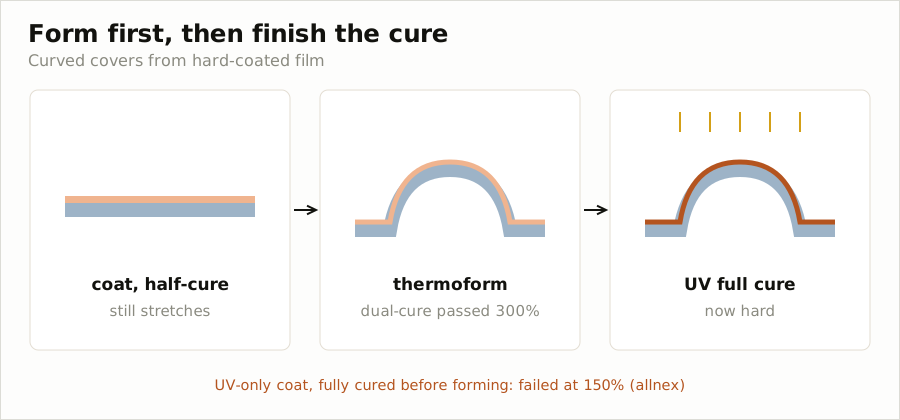
Curved covers are sometimes made by thermoforming a hard-coated film. A fully cured hard coat does not stretch, so it is half-cured before forming and fully cured with UV after forming. In allnex material, a coating made this way passed even when stretched 300%, while a coating cured by UV alone failed at 150%.
There is also the opposite route of curing first and forming afterward. Covestro formed a film, co-extruded with a PMMA layer on PC, with the hard coat already cured. Another patent from the same company named its own Makrofol TP 278 and MacDermid Autotype’s XtraForm as commercial examples of such formable hard-coated PC film.
Here, increasing the hard coat from 3 to 6 micrometers left pencil hardness unchanged, while increasing the PMMA layer from 15 to 65 micrometers raised it from HB to 2H. What set the grade was the substrate beneath rather than the hard coat.
AF, AG and AR stand on the hard coat
Most of the surface coatings covered in Part 2 lay a hard coat on film as their floor. The low-refractive-index layer of anti-reflection (AR) is the prime example. A low-index film made of hollow silica was H in pencil hardness on a hard coat, and fell short of even 6B on bare TAC.
The anti-reflection film Fujifilm disclosed also lays a 1-30 micrometer hard coat on TAC first, and then applies three layers of medium, high and low refractive index, each tens to a hundred nanometers thick, on top. Nanometer films cannot hold themselves up; they borrow the hardness of the floor.
Anti-glare (AG) is often the hard coat itself. Nitto Denko’s AG film disperses particles in the hard coat resin to create a surface roughness Ra of 0.05-0.15 micrometers. The same layer handles both hardness and roughness.
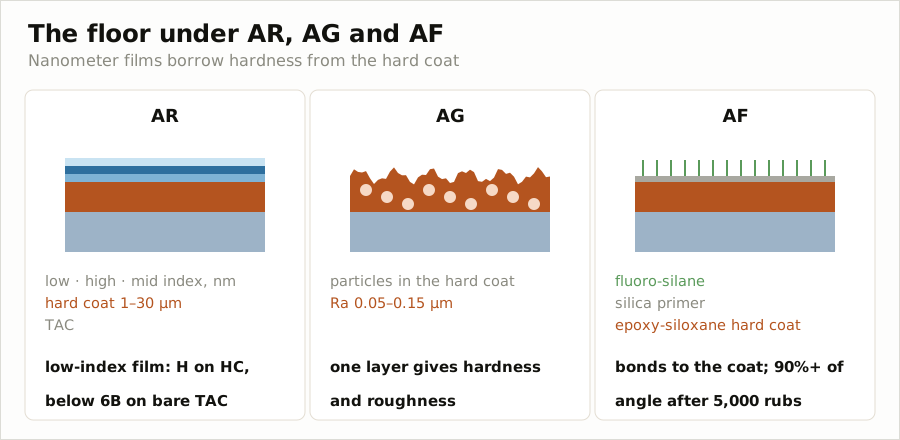
Anti-fingerprint (AF) lasts only if it is chemically bonded to the hard coat surface. KAIST researchers added a layer of silica primer on an epoxy siloxane hard coat to increase the sites where fluorosilane can attach, and reported that over 90% of the contact angle remained even after 5,000 steel wool cycles.
On UTG, a single hard coat layer sometimes takes on anti-fingerprint as well. NAMI claimed a water contact angle on the hard coat surface of 110 degrees or more initially, and 90 degrees or more even after 2,500 rubs with #0000 steel wool at 2.45N/cm².
The Nature Communications coating in Figure 1 also put “all-in-one multifunctional coating” in its title. It is a trend toward gathering functions once stacked as separate layers into a single hard coat layer. We will meet this trend again in the next episode.
Why does a softer layer win on glass?
On glass, adding hardness was not the answer. Both tempered glass and UTG went in the direction of making the surface softer than the glass.
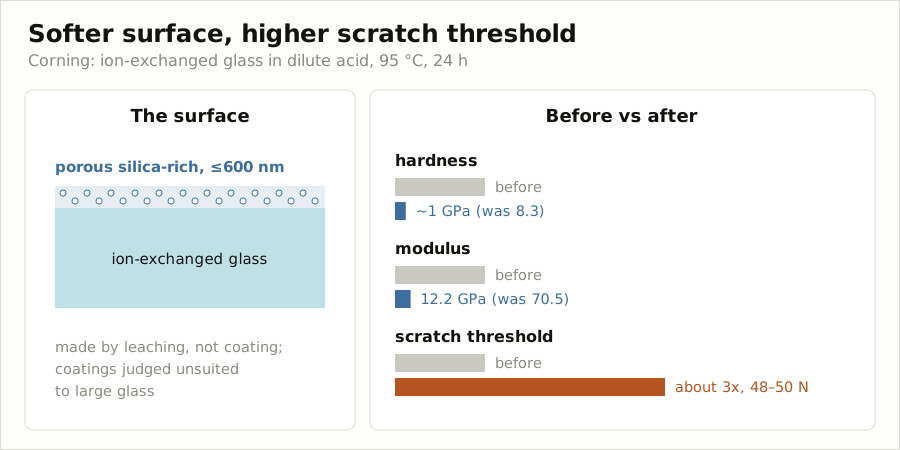
Corning wrote that putting a hard coat on glass does not suit large-area glass because of cost, scalability and loss of transparency. Instead, it immersed ion-exchanged glass in a dilute acid at 95℃ for 24 hours to leach out part of its composition.
That leaves a silica-rich porous layer 600 nanometers or less at the surface. This layer is softer than the original glass. Nanoindentation hardness fell from about 8.3GPa to about 1GPa, and the modulus from 70.5GPa to 12.2GPa.
Yet the load at which damage begins when scratched with a Knoop indenter became about 48-50N, about 3 times that before treatment. Corning wrote that across five glass compositions this value rose by up to 4 times. Strength after scratching was preserved too. Treated glass kept its strength when scratched at 40N, while untreated glass held only up to about 25N.
Hard coats on UTG go in the same direction. Their job is not scratch resistance but impact absorption. A soft layer laid on already-hard glass takes sharp impacts such as a pen tip.
Corning filed a structure with a 10-60 micrometer hexafunctional urethane acrylate hard coat attached on UTG of 75 micrometers or less. It has a pencil hardness of 8H or more, a pen drop height of 2 times or more that of bare UTG, and folds at a radius of 5mm or less.
Samsung Display filed a structure with a 3-30 micrometer hard coat of 15-40HV indentation hardness on 30-70 micrometer UTG. Converted to GPa, that is 0.15-0.39GPa, the same order of magnitude as the hard coat in Figure 1.
Samsung officially states that the actual Galaxy Z series is stacked, from the top, as a replaceable protective film, a protective layer on the UTG, and the UTG. It has not disclosed the material or thickness of each layer.
Harder is better only when the substrate is soft. When the substrate is film, the hard coat lends it hardness. When the substrate is glass, the hard coat instead guards the glass from the softer side.
The four substrates on one page
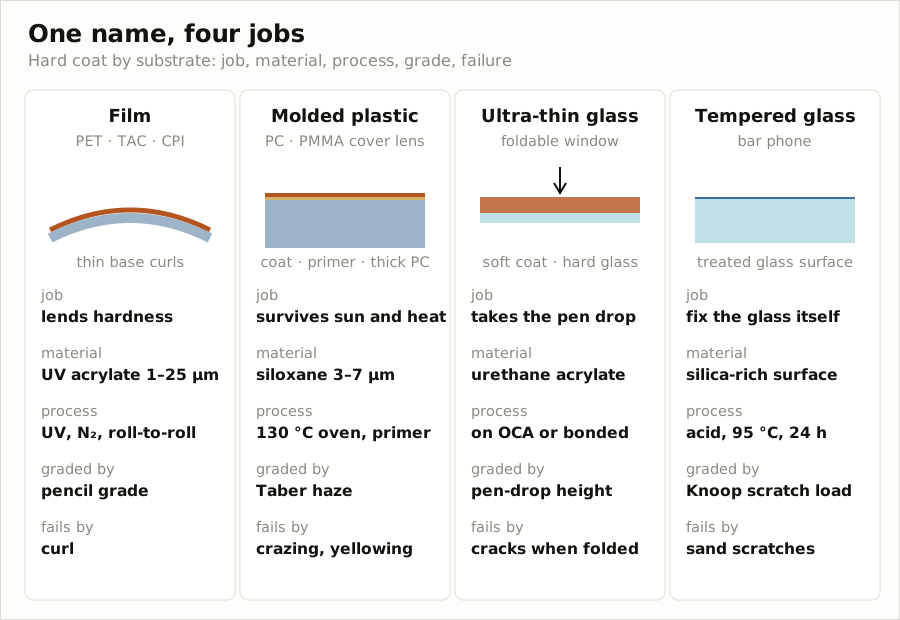
A hard coat on film lends hardness and fights curl. A hard coat on molded plastic withstands sunlight and heat and fights crazing. A hard coat on UTG takes impacts as a layer softer than the glass.
Tempered glass fixed the glass surface itself rather than coating it. Pencil 9H and pen drop multiples alike are numbers that can only be compared when the load and the substrate are written with them.
One thing remains. The hard coat on a foldable screen has to fold. Coat it thick and the grade goes up, but the radius it can fold to grows larger. The next episode looks at the hard coat that folds: flexible HC.