
Galaxy Z Fold8 and the history behind its Flex Titanium back plate
Foldable back plate materials have gone metal to CFRP and back to metal over eight generations. At the price of giving up the S Pen, the Z Fold8 changed not only the back plate but the film to metal as well, gaining a third of the thickness and 20 times the stiffness. Eight generations of change organized from primary material, for anyone tracking materials roadmaps.
This article was published before the English edition began, so the labels inside its figures and simulators are in Korean. The caption and the note under each figure are in English.
This column gathers the display industry stories that poured out over one week (Monday to Sunday) and digs a little deeper into the hottest single issue among them. For 3 to 9 August, this week’s hot issue was the “Flex Titanium” of the Galaxy Z Fold8.
A third the width of a hair. That is the thickness of the titanium film Samsung Display newly put into the Galaxy Z Fold8. This film has to be folded and unfolded hundreds of thousands of times.
Writing this material change as “plastic was abandoned for metal” makes it a wrong sentence. The foldable back plate was metal to begin with. From the first-generation Galaxy Fold in 2019 it used a stainless steel (SUS) plate, with etching to cut grooves at the folding region. It was metal that got pushed out of this position at one point. In 2021, when the S Pen arrived. What is happening now is closer to that displaced metal returning after 4 years, and stronger at that.
The metal the S Pen pushed out
From the Galaxy Z Fold3 (2021), Samsung decided to put an S Pen into its foldables. The problem was that the digitizer (a flexible printed circuit) recognizing the S Pen’s writing position gets on badly with metal. The stainless steel used as the back plate caused electromagnetic interference with the digitizer. In the end Samsung changed the back plate material wholesale, to carbon fibre reinforced plastic, CFRP. Lower in stiffness than metal, but a material that did not clash with the digitizer.
That exchange ran four generations and 4 years, from the Fold3 in 2021 to the Fold6 in 2024. To protect the S Pen, one of foldables’ core selling points, Samsung was conceding a step of back plate stiffness for all 4 years.
Fold the S Pen away and the metal comes back
The turning point is the Galaxy Z Fold7 of 2025. Samsung removed the S Pen digitizer in that model, a decision it admitted itself was a sacrifice for thinness. Stripping the digitizer layer from both sides of the folding panel reduces the folded thickness by 0.6mm. And that decision had a side effect. With no digitizer, returning the back plate to metal no longer caused interference. That is the background to titanium returning as the back plate from the Fold7. The Galaxy Z Fold8 keeps the S Pen unsupported and continues down that line.
What is newly different in the Fold8 starts here. Up to the Fold7, only the back plate, the support plate, was titanium. The Fold8 changed the film layer to a titanium alloy as well. Samsung Display gave this double structure combining film and support plate the name “Flex Titanium,” disclosing it separately on 15 July, a week ahead of the Unpacked event.
The price of changing the film to metal too
Titanium is not a metal made to be folded thin and flexible. High stiffness means it does not bend readily, a property unfavourable to a folding film. Samsung Display rolled this film out by an ultra-precision process to about a third the width of a human hair. The stiffness thereby secured is about 20 times that of a conventional polymer (plastic) film. At the same thickness titanium is a far stronger material to begin with, so the calculation is that a stiffness advantage remains even after being rolled thin.
Laser drilling of fine holes was applied at the folding region alongside. The smaller and denser the holes, the more densely adhesive can be filled in, and the impact arising when it folds is distributed rather than concentrated in one place. Support plate and film take stiffness, while the fine hole processing takes flexibility and impact distribution.
This processing method is backed not by marketing copy but by an actually granted patent. US11,812,566 (“Metal plate and display device including the same”), which Samsung Display filed in October 2022 and had granted in November 2023, specifies a structure placing “a pattern portion made of multiple openings” where the metal plate overlaps the folding axis, concentrating the tensile and compressive stress arising from bending into that pattern portion while leaving the rest of the plate as it is. Where the openings are dense the plate bends like the chain mail of armour, and where there are none it stays a rigid plate. That patent’s filing date is more than 3 years ahead of the Fold8’s launch. The “Flex Titanium” now visible is not marketing naming that appeared out of nowhere but closer to the result of extending a design accumulated in patents over years, this generation, as far as the film layer.
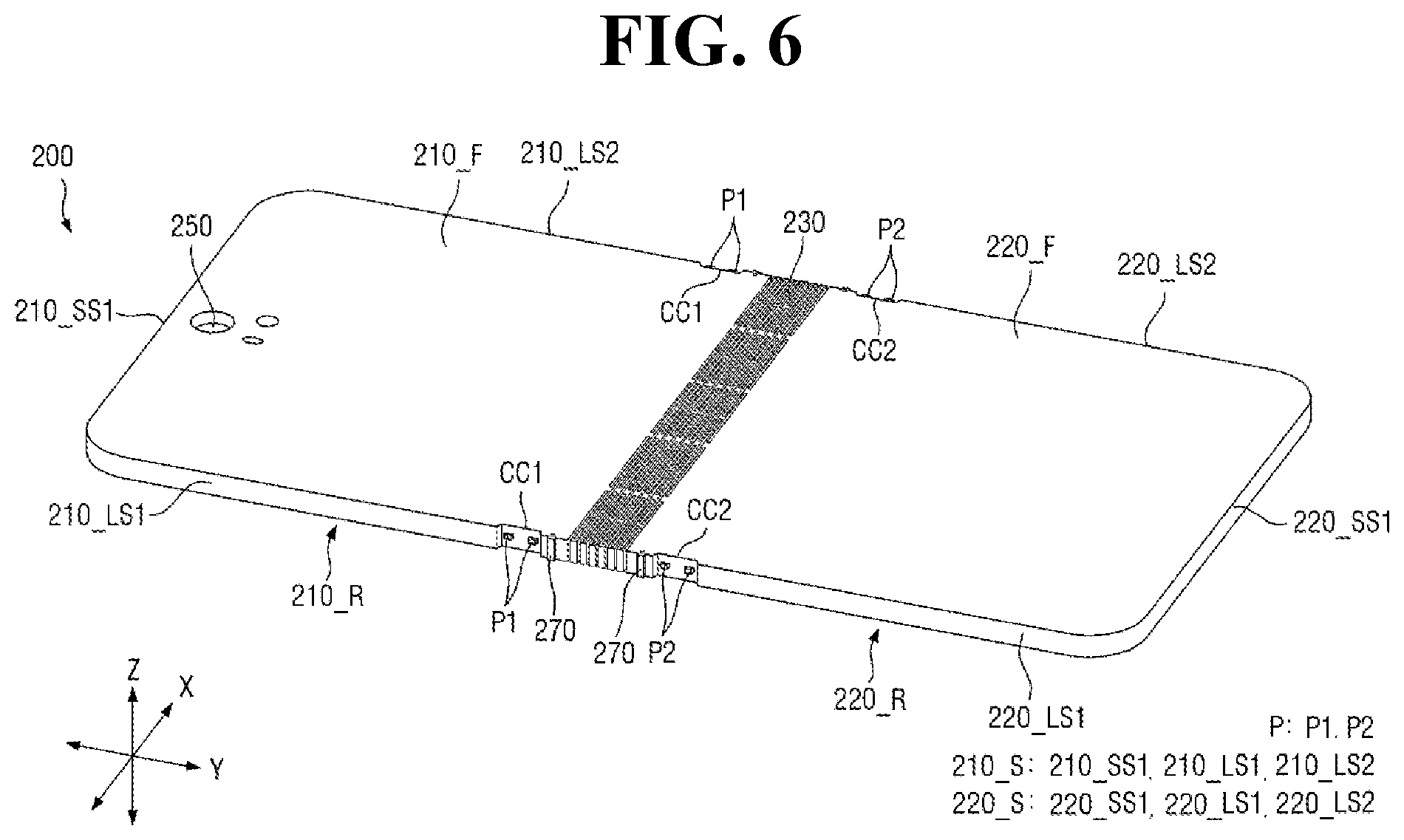 The hatched band crossing the middle of the phone-shaped plate is the “pattern portion (230)” in the patent figure Samsung Display filed in 2022. Holes are drilled densely only here, driving the bending stress into it. Source: US11,812,566, USPTO published material.
These changes together made the overall thickness 12% thinner than the previous generation, and the resolution was unified at 422PPI on both cover and main screens, an improvement of about 15% (the previous cover screen was 368PPI). Power consumption fell about 10%. The Fold8’s own folding durability test figure is not in this material, though. The 500,000-cycle pass is the record of the Fold7, which used only a titanium support plate, and whether the Fold8, with the film changed to metal too, has surpassed it has not yet been disclosed separately.
The price of titanium
This material change is not free. According to THE ELEC reporting, Samsung originally reviewed the Fold8’s back plate on a two-track basis, titanium and CFRP. The reason is supply chain. Titanium raw material procurement is heavily dependent on China, raising concerns about supply instability amid US-China trade friction. Processing difficulty is also higher than stainless steel. That Samsung finally put its weight behind titanium, and behind “Flex Titanium” extending it as far as the film, reads as a judgement that the benefits the material gives — stiffness, thickness and crease improvement — are large enough to bear that supply chain risk.
For the same reason Samsung Display is already preparing the next alternative. According to THE ELEC reporting in November 2024, Samsung Display began a project with several component partners to change the back plate material to glass. The rationale is light weight and low cost, plus, again, stability of material supply. It runs in the same direction as the move to reduce dependence on Chinese titanium raw material. An industry official said at the time that “mass production application will be difficult next year (2025) and only possible from 2026,” meaning reliability validation is not yet finished. The component maker Iljin Display separately disclosed its own development of a foldable glass back plate at the SEDEX exhibition in 2025, confirming that this current is not Samsung’s review alone.
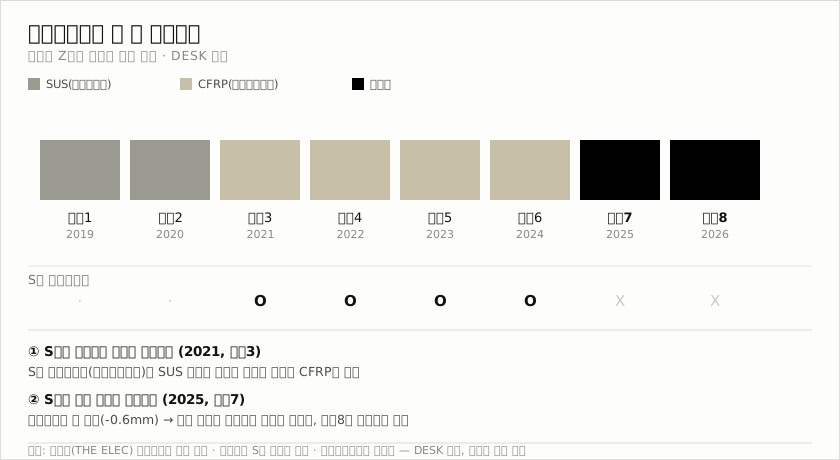 The graphic was produced by DESK, synthesizing generation-by-generation material and S Pen support information scattered across several sources including THE ELEC, BetaNews and the Samsung Display Newsroom. For sources see the list above.
Outlook
Titanium’s return is not chance but a position won at the price of giving up the S Pen. How long that position lasts therefore depends on two things. One is supply chain. That Samsung reviewed CFRP in parallel means it has an alternative ready to fall back on whenever titanium procurement runs into trouble. The other is the S Pen. According to BetaNews reporting, Samsung has not abandoned the S Pen entirely but is reviewing AES (active electrostatic) input technology, the Apple Pencil method. Unlike the EMR digitizer that caused the problem, AES needs no separate embedded digitizer layer.
This point matters. Switch to AES and the reason for the S Pen to clash with metal disappears even if it returns. In that case the likelihood of titanium being pushed out again for the same reason as 4 years ago is low. “Flex Titanium,” extending metal as far as the film layer, is a far larger investment than changing the support plate alone, and the period Samsung is betting on this material should be read as at least two to three generations. Titanium is more likely than a return to CFRP for the Fold9’s back plate.
The real variable that could break this current lies elsewhere, though. Not the S Pen’s return but glass. The glass back plate Samsung Display is preparing has “mass production possible from 2026” as its timing, which lines up with the Fold9 (expected 2027). It means the possibility cannot be excluded that the position titanium held even at the cost of supply chain risk is handed to glass, which removes that risk entirely, in the next generation. The observation point this article leaves is one: whether the Fold9’s back plate stays titanium or crosses to glass. That result is the surest next checkpoint still undecided at this moment.