
This issue's lead
Indium Phosphide Quantum Dot Synthesis: Four Patents Samsung Could Not Void
The cover shows how the size of each quantum dot sets its color. Even sizes give a narrow emission peak and a clean color; mixed sizes broaden it and muddy the color. Nanoco matched the sizes by seeding the growth with zinc-sulfur molecules that are all alike, and all four of its synthesis patents survived the petitions Samsung brought. The gold particles in the document Samsung filed as evidence were of mixed sizes, and the zinc in the earlier paper was a dopant mixed in at trace amounts rather than a seed.
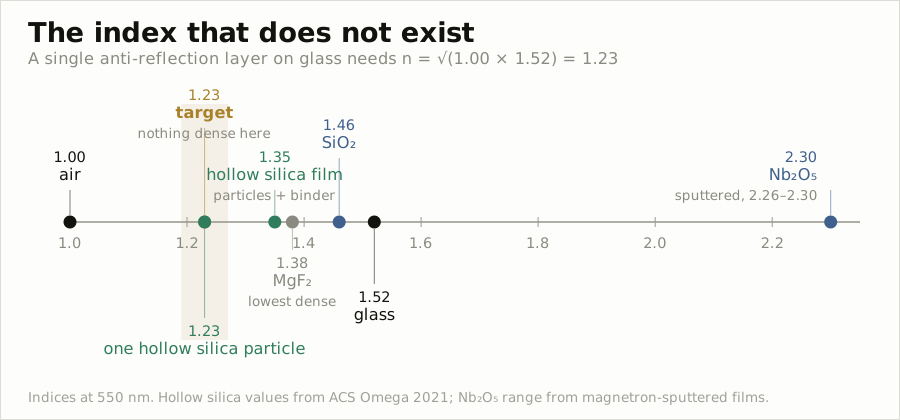
Cancelling reflection with one layer on glass calls for a material of refractive index 1.23, and no dense solid reaches it. LR approaches that value through the voids inside hollow silica, while wet-coated and sputtered AR stacks give up on index and cancel by interference instead. Both are designed against air, so when oil lands on them the stack that erased reflection most deeply is the one that fails hardest.
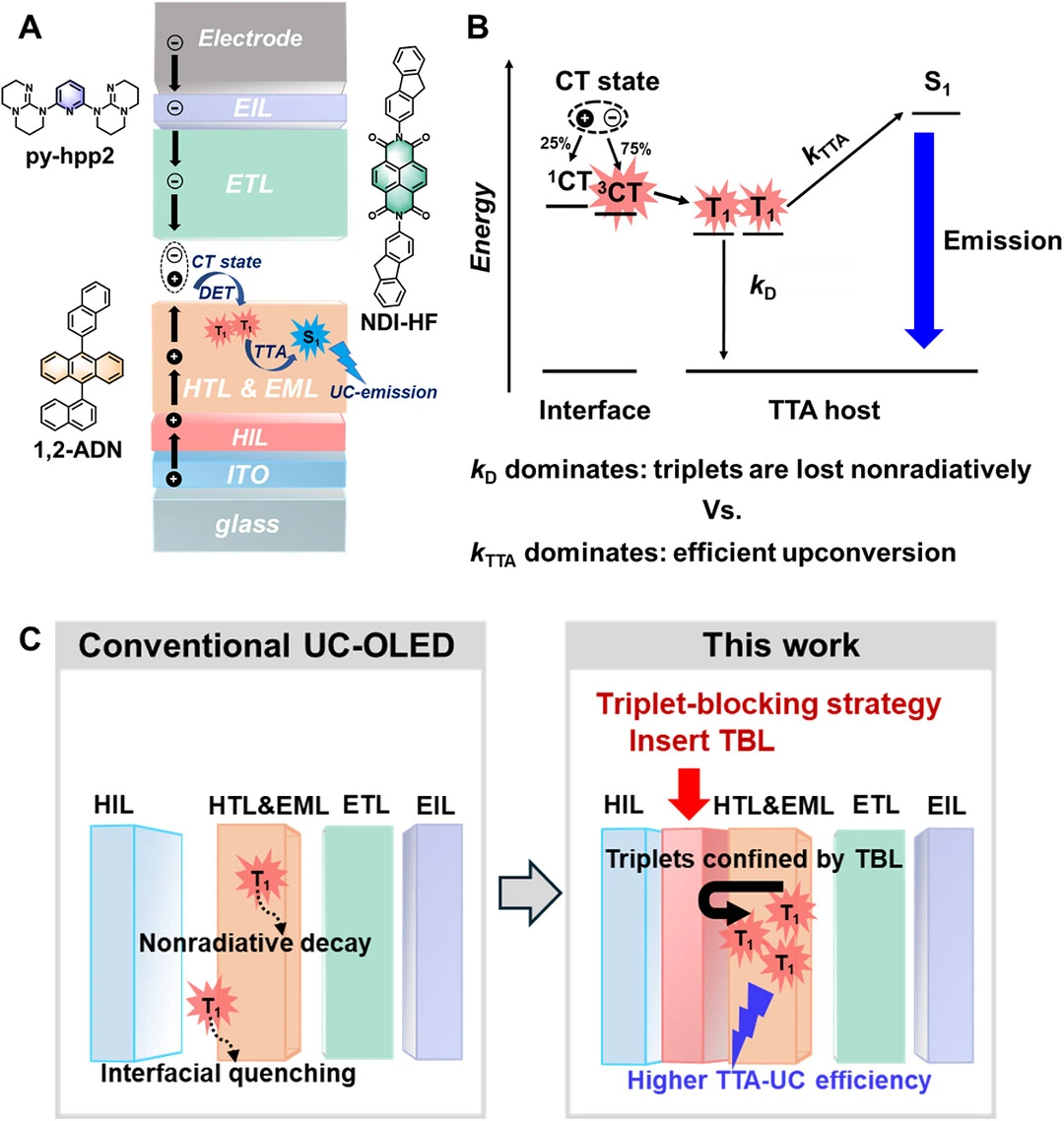
For most blue OLEDs, 2.7 V is barely the voltage at which light begins to show. A team at the Institute of Science Tokyo closed off the path by which triplets leak toward the anode, and got 1,000 cd/m² out of that same 2.7 V. The method is to gather low energy twice over to make blue. But the efficiency ceiling of this approach is 5.5%, and the device stands at 32% of it.
Twelve display-related papers, briefly introduced, picked out of 1,149 published in 28 major journals from 14 September to the morning of the 20th and narrowed to 117. Two more are covered as separate in-depth articles. What clustered this week was work that pulls more light out without changing the emitting material: polariton, plasmon and cavity arrived side by side in a single week.
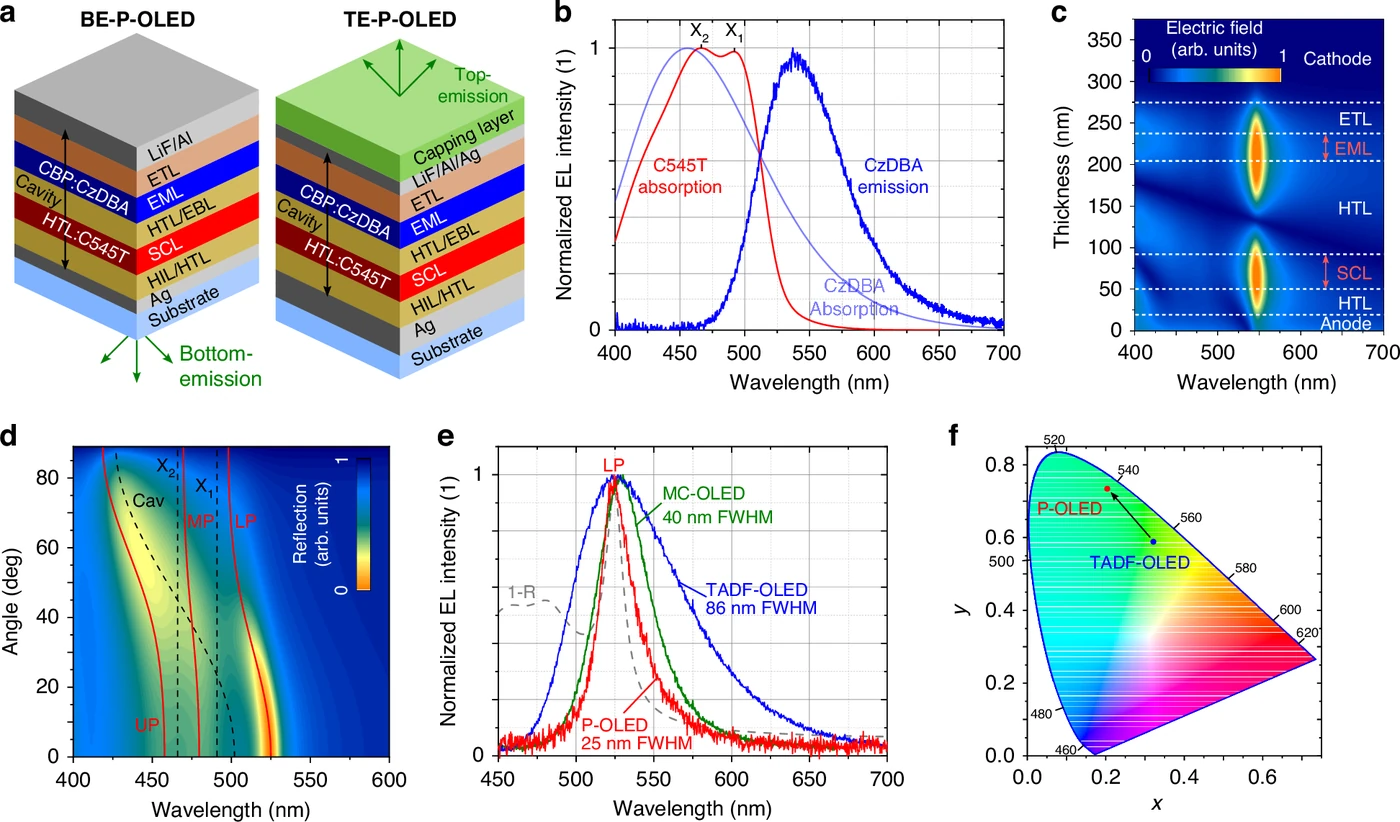
Look at an OLED screen from an angle and the colour changes. A microcavity purifies that colour but makes the shift worse. Researchers at the University of Cologne and the University of St Andrews pulled the emitting layer and the absorbing layer apart, and built an OLED with a 25nm linewidth whose colour moves only 10nm at 45 degrees. Read the table, though, and no single device had all three.
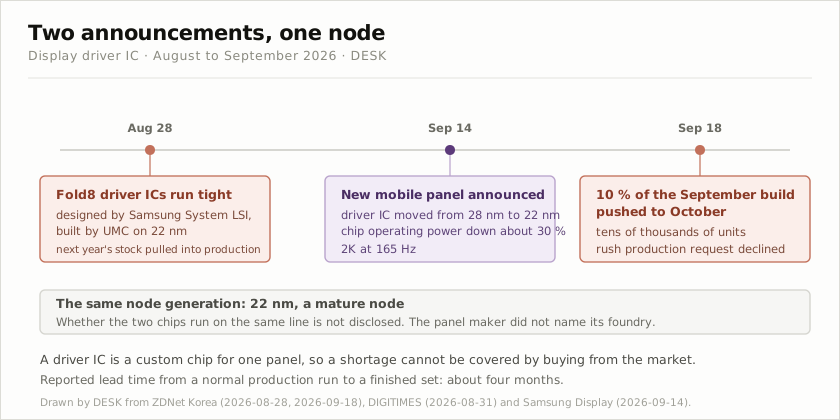
Two driver IC stories landed in the same week. Samsung Display said it had moved the driver IC for its new panel from 28nm to 22nm, and Samsung Electronics pushed 10% of its Galaxy Z Fold8 component production plan to the following month because driver ICs were short. Both stories point at the same 22nm. What decides when panels get better turned out to be not the panel fab but the room left on a mature node foundry line.