
iPhone Duo keeps its pen despite a titanium plate
Apple has released its first foldable, the iPhone Duo. Its crease fix adds one more process on top of materials: measuring and correcting each unit. Samsung set the pen aside on its foldable because of titanium, but Apple kept the pen with titanium inside, because it reads the pen differently. The iPhone Duo is 27% thicker than the Galaxy Z Fold8 Ultra. The cause is neither the pen nor the battery count but the halves themselves, and public data cannot yet divide that share.
Hot Issue of the Week
This column gathers the display industry stories that filled one week (Monday to Sunday) and digs a little deeper into the single hottest one.
The stories the press ran from 7 to 13 September
One product took almost all of this week’s pages. Apple unveiled its first foldable iPhone on 9 September (local time), and stories on panel supply and market outlook lined up before and after it.
First, Apple’s iPhone Duo was the thickest strand. It pairs a 7.6-inch inner foldable OLED with a 5.4-inch outer screen, and its Korean price is 3,290,000 won for the 256GB model. Pre-orders open on 16 October and sales begin on 23 October.
Reports followed that Samsung Display will supply the panel exclusively for three years. Analysis was added that a foldable panel costs 3 to 4 times as much as a bar-type panel. UBI Research expected the foldable OLED market to reach 55 million units and $5.5 billion in 2030.
Second, Huawei unveiled the tri-fold Mate XT 2 on 7 September. The first generation used a Z-shaped structure that folded once inward and once outward, so part of the screen was exposed. This time both folds go inward. It opens to 10.2 inches, and a model with a hardware privacy feature in the folding inner screen also came out.
Third, LG Display was picked as Sharp’s sole supplier of large WOLED. This is part of Sharp moving its TVs and monitors to OLED after withdrawing from large LCD.
Fourth, chipflation is spreading into displays. Because of memory prices, the average selling price of smartphones was forecast to rise 27.6% to $581 and shipments to fall 12%. Samsung Display President Yi Chung said price-cut pressure is coming on the display side.
Fifth, two panel supply outlooks came out. Sigmaintell put LG Display’s iPhone OLED shipments at 81 million units (up 11% year on year). UBI Research gave compound annual growth rates for mid-to-large OLED revenue of 60% for Samsung Display and 34% for LG Display.
Sixth, there was news from materials and equipment. UDC explained its plans for Gen 8.6 IT OLED and for commercialising blue phosphorescence. Shindo Engineering introduced the through-glass-ceramic via (TGCV), which makes up for the thermal and mechanical limits of the through-glass via (TGV). It is a material to read as a follow-up to last issue’s glass core substrate piece.
Of these, the conversion of LG Display’s Paju Gen 8.5 line for FLiPP, automotive OLED market share, and Samsung Display’s investment in Asan Complex 2 were already covered through the previous issue, so they are not opened again here.
The hottest issue from 7 to 13 September is “Apple iPhone Duo.”
Start with the numbers Apple published
The iPhone Duo is 5.2mm thick unfolded and 11.3mm folded, and weighs 254g. The inner screen is 7.6 inches at 1878×2670 resolution and 430ppi. The outer screen is 5.4 inches at 1398×2034 and 460ppi.
The inner screen’s aspect ratio is 2670÷1878, about 1.42. That is not the ratio of two tall bar phones joined together. It is closer to a passport or a pocket notebook, and Apple chose a wider screen when unfolded.
Most press coverage picked out two things. The crease is almost invisible, and the phone is thicker and heavier than the Galaxy Z Fold8. There is one more. It is the first iPhone to support Apple Pencil. This article looks at these three in turn.
How the iPhone Duo’s crease-free design differs from other foldables
The iPhone Duo’s answer to the crease adds one more process on top of materials. Apple said that during production it uses AI to pair each hinge with the housing it fits best. It then scans the surface shape of every single unit with a confocal laser and 3D-prints up to 25 layers of custom photopolymer to remove the remaining unevenness.
Johny Srouji, Apple’s senior vice president of hardware technologies, gave this explanation himself. The key point is that it is not one design, but measuring and correcting each unit. Units built from the same drawings still each have their own deviation. This approach measures that deviation and fills it for that unit.
There are material countermeasures too, of course. Apple described the folding screen as 10 ultra-thin layers. On top is a custom polymer cover that Apple says is 40% harder than other materials in the industry. High-strength glass sits above and below the display, and a titanium plate sits at the very bottom.
Custom adhesive goes between the layers. Apple explained that this adhesive lets the layers slide against one another like the pages of a book, relieving bending stress. When the screen folds, the outer layers stretch and the inner layers compress. If the layers can shift slightly against each other, that difference does not concentrate in a single layer.
Up to this point, other companies take the same road. The Flex Titanium that Samsung Display put into the Galaxy Z Fold8 is also a materials-and-structure countermeasure. It switches the support plate and film to metal and drills micro-holes in the folding area to spread stress.
What differs is the process added on top. In public materials, we found no foldable maker other than Apple that has disclosed a process that scans every single unit and corrects it by building up layers.
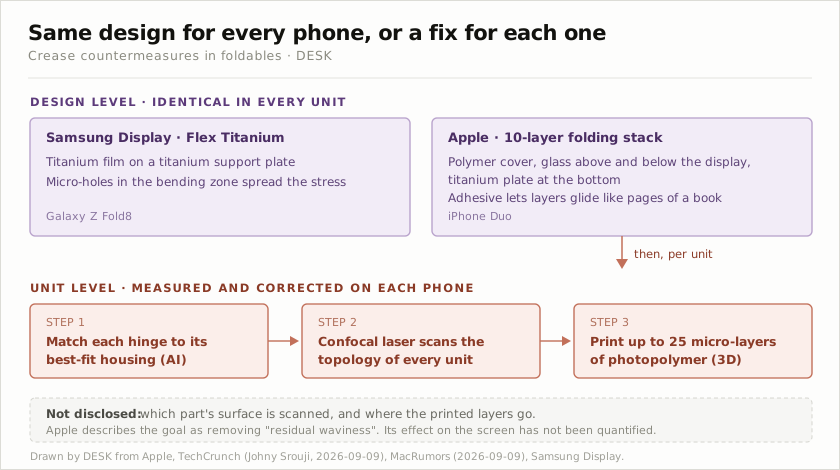
There are two things Apple has not disclosed, however. Exactly which component’s surface the laser scans, and where the 25 layers are built up. Srouji’s remarks came in the context of explaining hinge manufacturing. Nothing in the public materials establishes that this process directly fills the area under the screen.
So this is as far as we can go. Apple did not reduce the crease with materials alone. It added a process that measures the deviation of the folding structure unit by unit and removes it. How much that process contributes to the screen has not yet been put in numbers.
How Apple kept the pen in a foldable with titanium inside
Apple has always used a capacitive pen that needs no digitizer, so it could keep the pen even with titanium inside. Samsung set aside its electromagnetic resonance (EMR) S Pen on its foldable because of the same titanium. What separated the two companies was not the metal but the way the pen is read.
Start with Samsung. The S Pen uses Wacom’s EMR method, which needs a separate digitizer layer under the screen to read the pen signal. In July 2025, with the Galaxy Z Fold7, Samsung removed this digitizer and cut thickness by about 0.6mm.
Reports at the time gave the reason as follows. The EMR S Pen interfered with the new titanium metal material and became hard to use. The digitizer exchanges an electromagnetic field with the pen, and a metal plate right beneath it disturbs the signal. The background is laid out in the 13 August Flex Titanium piece.
The iPhone Duo also has a titanium plate at the bottom of its folding screen. Its outer enclosure is 85% recycled titanium as well. Yet Apple Pencil works on both the inner and outer screens.
The difference is that Apple Pencil is read by the screen’s capacitive touch sensor. The layer that reads finger touch also reads the signal from the pen tip. So there is no separate layer for the pen, and no metal plate for such a layer to clash with. The active electrostatic (AES) method belongs to this family. Samsung was reported to be considering AES as an alternative foldable pen at the time of the Z Fold7.
The direction of cause needs to be clear. Apple did not choose this pen method in order to add titanium. Apple Pencil has been capacitive since the iPad. The right reading is that this is what let Apple keep the pen while adding titanium.
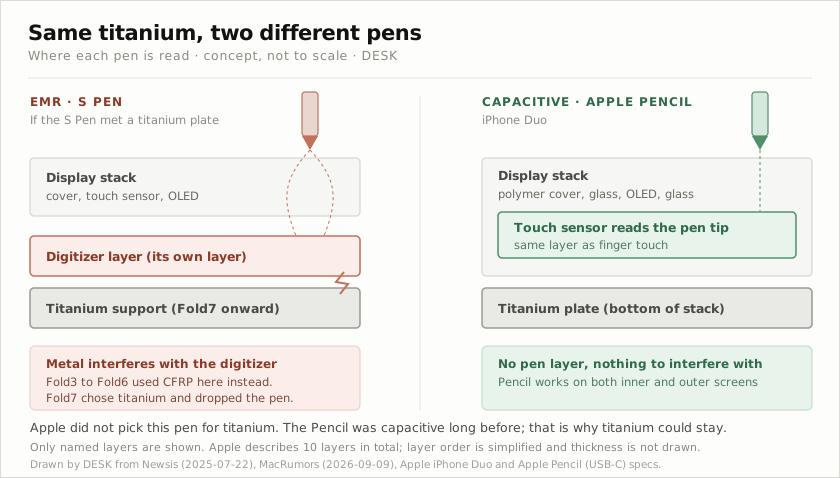
Samsung Electronics patent US12260058B2 explains this interference directly. The digitizer sits right under the display, and the metal plate sits beneath it. The pen’s magnetic field induces eddy currents in the metal plate. The patent states that those eddy currents create a magnetic field opposite to the pen’s, weakening the pen signal and distorting the coordinates.
The reason the capacitive method avoids this problem lies in the layer order. Directly under the touch sensor, a thin metal film called the OLED cathode covers the whole screen. The electric field from the pen tip ends at that cathode. No electric field reaches the titanium plate below it.
A metal plate does not, however, mean that EMR is impossible. Patents from Samsung Electronics and 3M present ways to reduce eddy currents by cutting slits in the plate or inserting a magnetic shielding sheet. On the Z Fold7, Samsung did not choose to add countermeasures. It chose to remove the digitizer and cut thickness.
The digitizer-free pen Samsung has been preparing has sat at the threshold of mass production for four years
Samsung Display has been developing, with HiDeep, a technology that reads the pen through the screen’s touch electrodes without a digitizer layer. That technology, however, has never gone into a mass-produced product.
HiDeep first announced a mass production date in 2022. As of March 2026, the target has retreated from “mass production” to “securing a mass production model”.
This technology is not an Apple-style capacitive pen but a variant of EMR. The pen holds only a resonant circuit of a coil and a capacitor, with no battery, and in that respect it is the same as the S Pen.
The difference is that the job of sending a signal to the pen and reading the resonant signal that comes back falls to the screen’s touch electrodes rather than a separate digitizer. If it works, the pen needs no battery, like the S Pen, and the device has no layer for the pen, like Apple’s.
HiDeep patent US11675446B2 (granted 2023) describes a structure in which the touch electrodes send a signal at the pen’s resonant frequency and find the position where the direction of the current the pen induces in the electrodes reverses. US12141375B2 (granted 2024) covers a configuration that reads a resonant pen with existing metal mesh touch electrodes.
The mass production target slipped twice
| Reported | Stated target | Source |
|---|---|---|
| April 2022 | Mass production of products using the stylus and touch solution from the second half of 2023 | The Elec |
| December 2024 | Cooperation with Samsung Display, mass production targeted for the second half of 2025 | The Elec |
| March 2026 | Passed global customer performance evaluation, aims to secure a mass production model in 2026 | ZDNet Korea |
HiDeep’s 2025 sales were 1.77 billion won, down 70% from the year before, and the company attributed this to delays in the adoption of its integrated touch and stylus solution. The 2025 sales forecast presented in its 2022 prospectus was 383.4 billion won.
Over the same period, Samsung Electronics’ foldables did not get the pen back. In December 2024 a report said a digitizer-free pen input was being considered for the Galaxy Z Fold7, and that report described the method as capacitive. The Z Fold7, launched in July 2025, dropped the S Pen, and the 2026 Z Fold8 does not support a pen either.
One thing is not confirmed by public sources. How reading a resonant pen through touch electrodes coexists with a titanium plate under the display is not disclosed in any patent or report. Losing the digitizer layer solves the thickness problem, but whether it also solves the metal plate problem is a separate question.
The pen features are those of the iPad’s USB-C Pencil
The iPhone Duo supports one model only, Apple Pencil (USB-C). It detects tilt, but it does not support pressure sensitivity, haptics, squeeze, double-tap or barrel roll. The higher-end Apple Pencil Pro cannot be used.
This list should not be read as cut down because the phone is foldable. Apple Pencil (USB-C) has no pressure sensitivity on the iPad either. Its official specifications highlight three things: pixel-level precision, low latency and tilt sensitivity. The pen’s own feature range has carried over unchanged.
Timing matters too. Apple said that Pencil support will not be included when sales start on 23 October, and will be added later this year. The hardware is ready, and the software follows.
Why the iPhone Duo is thicker than the Galaxy Z Fold8 Ultra
With the data published so far, the answer cannot be settled. We can confirm that the pen and the number of batteries are not the reason. Two candidates remain: battery capacity and water-resistance rating. Unfolded, the iPhone Duo is 5.2mm, 1.1mm thicker than the Galaxy Z Fold8 Ultra (4.1mm). Folded, it is 11.3mm, 2.4mm thicker than the Ultra’s 8.9mm.
| Spec | iPhone Duo | Galaxy Z Fold8 Ultra | Galaxy Z Fold8 |
|---|---|---|---|
| Unfolded | 5.2mm | 4.1mm | 4.5mm |
| Folded | 11.3mm | 8.9mm | 9.7mm |
| Weight | 254g | 215g | 201g |
| Battery | Dual, capacity undisclosed | Dual, 5,000mAh | Unconfirmed |
| Water resistance | IP68 | Unconfirmed | IP48 |
| Pen | Apple Pencil (USB-C) | Unconfirmed | Not supported |
The difference is in the halves themselves
Setting the two figures side by side shows where the difference is concentrated. The unfolded difference is 1.1mm, or 27%. The folded difference is 2.4mm, also 27%. The equal ratio means that the halves themselves are thicker, not the gap between the two folded halves.
A calculation confirms it. Subtracting two unfolded thicknesses (10.4mm) from the iPhone Duo’s folded thickness of 11.3mm leaves 0.9mm. For the Galaxy Z Fold8 Ultra, 8.9mm minus 8.2mm leaves 0.7mm. The gaps differ by 0.2mm, and the remaining 2.2mm comes from each of the two halves being 1.1mm thicker.
The pen is not the reason
If the pen had added thickness, it would have to be in a digitizer layer. The thickness Samsung gained by removing its digitizer was about 0.6mm. But the iPhone Duo has no digitizer layer. Apple Pencil is read by the touch sensor, so no layer was added for the pen. The pen drops out as a reason for the thickness.
The number of batteries is not the reason either
The explanation that the iPhone Duo is thick because it has two batteries does not hold. The Galaxy Z Fold8 Ultra also has dual batteries. Splitting the battery in two is not in itself a difference between the two products.
Two candidates remain, and they cannot be separated yet
The first is battery capacity. Apple’s specifications say only “dual built-in lithium-ion batteries” and give neither capacity nor chemistry. The Galaxy Z Fold8 Ultra has 5,000mAh. If the iPhone Duo’s capacity is larger, that could be one reason its halves are thicker.
Capacity cannot be back-calculated from the usage times Apple published (up to 31 hours of video playback on the inner screen and up to 44 hours on the outer screen). Chip and panel power efficiency differ from company to company, so the same hours do not mean the same capacity.
The second is the water-resistance rating. The iPhone Duo is rated IP68 (6m depth, 30 minutes), and the Galaxy Z Fold8 is rated IP48. The second digit is the same 8, but the first digit is the dust protection rating. The iPhone Duo in effect has sealing that blocks even fine dust. Keeping dust out of a folding structure may take more parts to close the gaps.
However, we could not confirm the rating of the Galaxy Z Fold8 Ultra, whose thickness is compared here, so this contrast is based on the standard model.
Still, how many mm sealing adds to thickness has not been published anywhere. Battery capacity has not been published either. Current data cannot separate how much each of the two candidates accounts for. Going further and writing down a ratio would be invention, not estimation.
Battery capacity would narrow it down
If battery capacity is published, it becomes a clue for narrowing down the candidates. Battery capacity sometimes appears first in certification filings in various countries before launch, and sometimes comes out through teardowns after sales begin. If the capacity turns out similar to the Galaxy Z Fold8 Ultra’s, the centre of gravity of the thickness question shifts toward sealing and layering.
Even so, a teardown is not the answer by itself. A teardown shows the thickness of the parts but does not say why that thickness was needed. Even when the capacity comes out, what it gives is only a clue for gauging the relative weight of the two candidates.
Outlook
The question the iPhone Duo put to the foldable industry is about the pen more than the crease. Samsung has also kept reducing the crease through materials and structure. Apple only added a process, and the direction is the same. The pen, by contrast, differs in method, and as long as titanium is used it is hard to go back to the existing EMR approach that lays down a digitizer layer.
That is why we think that if Samsung brings the pen back to its foldables, it will not be by reviving the digitizer layer. That would mean putting back the layer it removed to cut thickness. Two paths remain: an Apple-style capacitive pen, and the touch-electrode resonant pen it has been developing with HiDeep.
Minseok Kang, Vice President of Samsung Electronics’ MX Business, said at the time of the Fold7, “We are preparing and researching thinner and more innovative technology.” Either way, that technology has not yet come out in a mass-produced product.
There are three ways to check whether this judgment is right. First, will the iPhone Duo’s battery capacity be revealed through certification filings or a teardown? If it is, one of the two thickness candidates can be narrowed down. Second, will Pencil support arrive this year as promised, and will handwriting quality on the unfolded screen match the iPad’s? The key is whether pen recognition wavers over the fold.
Third, if Samsung’s next foldable supports a pen, which method will it use? If it is a capacitive pen carrying a battery, Samsung has followed Apple’s path. If it is a battery-free resonant pen read by the touch electrodes, a technology that sat at the threshold of mass production for four years has crossed it for the first time.
Before that, the thing to watch is whether HiDeep actually secures the mass production model it has targeted for 2026. The third question will be answered last, but it is that answer that sets the direction of foldable pen technology.